


 中文简体
中文简体  Español
Safety Power Strip Guide: Key Features, Standards and Buying Checklist
 2026.09.03
 Industry News
Plug a 1,500 W space heater into a power strip already running a desktop PC, two monitors, and a pair of speakers, and you are asking a cord rated for 1,800 W to carry roughly 2,400 W through a plastic housing sitting on carpet. That single mismatch—not the number of outlets—explains most of the power strip failures that show up in incident reports and recall notices. A safe power strip comes down to three verifiable things: overcurrent protection matched to the cord, certification for the market where it will be used, and a connected load the wiring can actually carry. Everything else, from USB ports to extra sockets, is convenience rather than safety.
What Actually Makes a Power Strip Safe
Overcurrent protection is the core feature
In North America, a compliant strip is listed to UL 1363, the standard for relocatable power taps. Listing requires an integrated circuit breaker—typically 15 A—along with construction and temperature tests covering the cord, housing, and outlets. The breaker has one job: trip before the cord's insulation heats beyond its rated limit. If packaging only mentions surge protection tested under UL 1449, that covers voltage spikes, not overloads, and it does not replace the breaker. In fused markets such as the United Kingdom, the same protection lives inside the plug: a BS 1363 strip relies on the 13 A fuse fitted in its plug top, which is why a damaged or bypassed fuse carrier counts as a serious defect.
Surge protection answers a different question
Surge protectors and safety strips solve separate problems. Surge performance is measured in joules absorbed and clamping voltage during events such as lightning-induced transients. A strip can be perfectly safe without any surge components, and a surge unit can still be dangerous if the connected load exceeds the cord rating. For desk, television, and workshop setups, the overload path—not the transient path—is the one that actually starts fires, so treat surge specifications as a bonus rather than the definition of safety.
Features Worth Checking Before You Buy
Beyond certification, the difference between a strip that lasts decades and one that fails quietly comes down to a handful of construction details:
- A resettable circuit breaker rated at or below the cord's ampacity, so an overload trips protection instead of cooking the cable.
- A fuse in the plug for UK-format strips; the 13 A fuse is the primary overcurrent device and must suit the intended appliance mix.
- Individual switches per outlet, which let you de-energize idle sockets and cut standby draw instead of leaving five devices live around the clock.
- A flame-retardant housing in ABS or polycarbonate with a UL 94 V-0 rating, which resists ignition and self-extinguishes if a socket does arc.
- A cord gauge matched to the rating: at least 14 AWG (about 2.08 mm²) copper for a 15 A North American strip, or 3G1.5 mm² for a 16 A European one.
- Shuttered outlets that block dust, debris, and small objects from reaching live contacts.
- Weather protection for damp or outdoor locations; anything near water should carry at least IP44, with sealed plugs and gasketed covers.
Switched strips show how these details work together in practice. An Australian-style six-outlet unit with individual switching, for example, lets a user isolate four idle devices at the wall while keeping a router and monitor live—a small habit that lowers both standby consumption and the chance of a fault developing unnoticed.
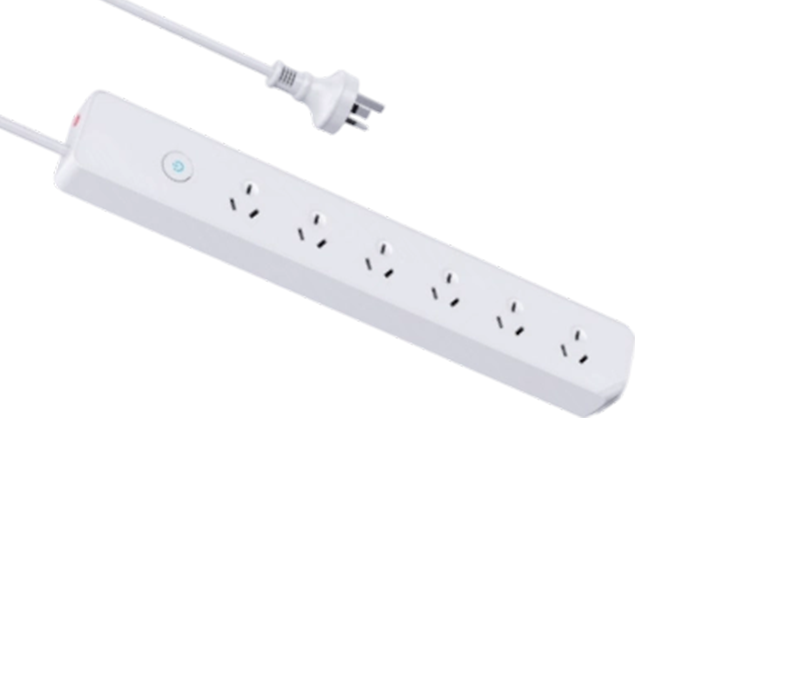 AU04 Australian-Style Power Strip with Six Outlets, With SwitchA six-outlet switched strip rated 240V 10A (2400W) for Australian-style circuits. Individual switching lets users cut standby power at the wall, making it a practical match for the multi-outlet formats buyers source across different regions.View Product →
Match the Strip to the Market and the Load
Plug and socket standards differ from country to country, and so do the ratings a strip must respect. A strip built for a 120 V, 15 A North American circuit is not interchangeable with one designed for 230 V European wiring, because cord insulation, contact spacing, and protective-device behavior are all specified against different supply conditions. The table below summarizes the four formats buyers source most often.
| Market | Supply conditions | Dominant standard | Practical load limit |
|---|---|---|---|
| North America | 120 V, 15 A branch circuits | NEMA 5-15 plug, UL 1363 strip | 1,800 W total; about 1,440 W for continuous loads |
| UK and Ireland | 230 V | BS 1363 fused and switched strips | Set by the plug fuse, 13 A maximum |
| Continental Europe | 230 V | Schuko-compatible, 16 A inlets | 3,680 W with a 3G1.5 mm² cord |
| Australia and New Zealand | 230 V | AS/NZS 3112 plug, 10 A strip | 2,400 W total |
For European distribution, a switched strip built around 16 A inlets and a 3G1.5 mm² cord keeps the overload math honest: the protective device trips well before the cord is stressed. Buyers shipping to mixed regions often standardize on switched models market by market rather than adapting a single design everywhere, because fuse placement and contact geometry cannot be retrofitted after production.
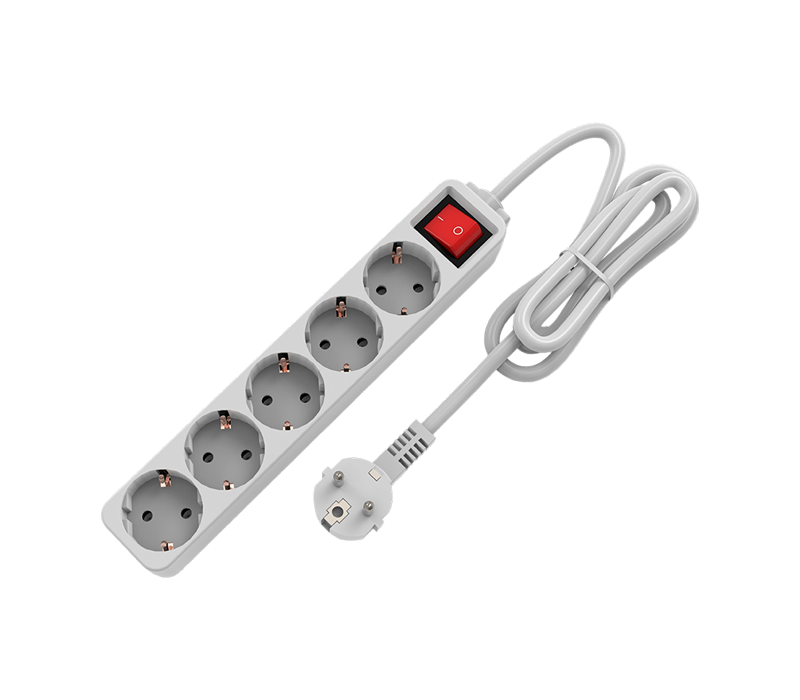 E10-5 European-Style Power Strip with Five Outlets, With SwitchA five-outlet switched strip rated 220-250V 16A with a 1.4-meter pure copper cord and flame-retardant PP housing. Suited to European distribution, where matching 16 A inlets to the right cord sizing keeps overload protection working as intended.View Product →
The Misuse Patterns Behind Most Strip Failures
Most strip-related incidents trace back to a handful of repeat offenses rather than to manufacturing defects:
- Daisy-chaining strips. Plugging one strip into another multiplies outlets but not ampacity; the single wall cord still carries everything, and the intermediate plug becomes a high-resistance heat point.
- Running high-draw appliances. Space heaters, kettles, hair dryers, and portable air conditioners each draw 1,200–1,800 W. One such appliance can consume a strip's entire rating, and two will exceed it.
- Using strips as permanent wiring. Routing cords through walls, under rugs, or across door frames hides heat and mechanical damage, both of which accelerate insulation breakdown.
- Ignoring the environment. Strips used near sinks, in gardens, or on workshop floors with conductive dust need sealed, weather-rated designs—not an indoor strip balanced on a ledge.
- Coiling cords under load. A cord wound onto a drum or bundled in a tight loop sheds heat poorly; sustained current through a coiled cord can soften insulation even when the breaker holds.
Cable-reel designs address the trailing-cord problem directly: the European-style retractable-cord strip pays out only the length needed and stores the remainder on a managed drum, which reduces trip hazards and keeps surplus cable off the floor. The standing caveat applies all the same—unwind a reel fully before running a sustained heavy load, because heat dissipation drops sharply while cable stays coiled.
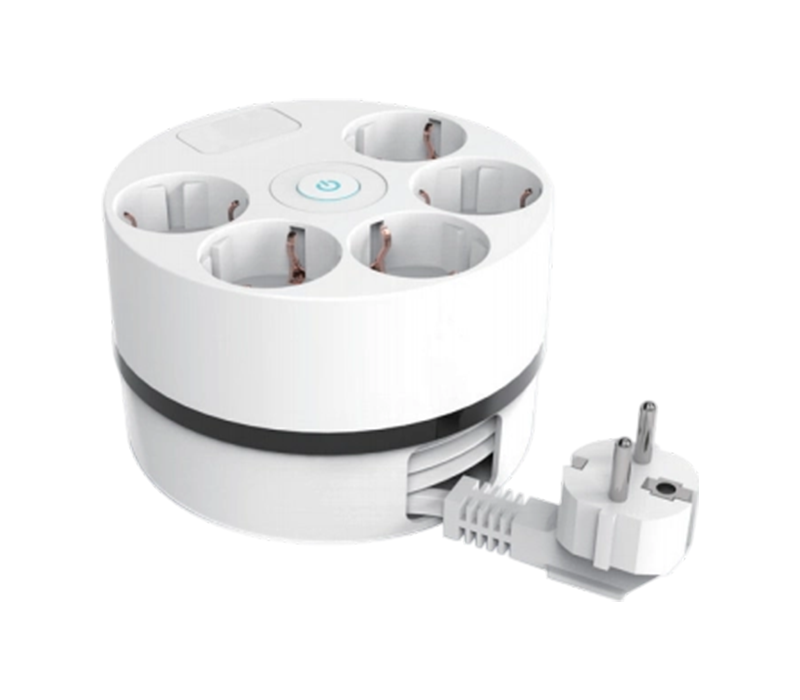 E17 Cable Reel Power Strip with Retractable Cord, 5 European-Style Outlets, Switch IncludedA retractable-cord strip with five European outlets, rated 220-250V 16A, that stores unused cable on a drum to cut trip hazards. Remember to unwind fully before sustained heavy loads, since coiled cable dissipates heat poorly.View Product →
A Pre-Purchase Checklist for Buyers
Run every candidate strip through five checks before placing an order:
- Confirm the certification mark matches the destination market: UL or ETL listing in North America, BS 1363 fuse marking in the UK, CE conformity with applicable EN standards in Europe, and RCM for Australia and New Zealand.
- Verify that the breaker or fuse rating sits at or below the cord's ampacity, and that the cord gauge is printed or stamped on the jacket.
- Add up connected loads before installation and keep continuous loads to roughly 80 percent of the strip's rating.
- Check the environment: sealed and IP-rated construction for damp or outdoor spots, a cord long enough to avoid extension chains, and mounting options where the strip will live permanently.
- Inspect construction quality: shuttered outlets, a V-0 flame-retardant housing, and strain reliefs at both cord ends.
For distributors and OEM buyers, a power strip should be treated as a system—plug, cord, protective device, and outlets—where every component has to match the destination market's rules. Manufacturers that produce their own plugs and cords across multiple national standards can build each strip to the certification requirements of its target market instead of adapting one design to fit all of them, and the full power strip range shows how that translates into Australian and European formats, from switched six-outlet units to retractable-cord reels. Choose the protection first and the outlet count second; that ordering is what separates a strip that lasts from one that quietly becomes the weakest link in the room.
Latest News

Contact Us
LET'S START COLLABORATING
 Ningbo TOP Electromechanical Co., Ltd.
specializes in the R&D and manufacturing of
wires & cables, plugs & sockets, waterproof LED connectors, and more. Ourproducts
meet multiple international certifications and are widely used in global markets.
Ningbo TOP Electromechanical Co., Ltd.
specializes in the R&D and manufacturing of
wires & cables, plugs & sockets, waterproof LED connectors, and more. Ourproducts
meet multiple international certifications and are widely used in global markets.
STAY CONNECTED
 Phone:+86-13586690829
Tel:+86-0574-62135837-801
 [email protected]
[email protected]
 Sibei Industrial Yuyao City, Ningbo, Zhejiang, China
MOBILE
Copyright © Ningbo TOP Electromechanical Co., Ltd. All Rights
Reserved
 Custom Electrical Power Cord Manufacturers