


 中文简体
中文简体  Español
LED Connector Harness Buying Guide: Pin Counts, IP Ratings, and Applications
 2026.08.27
 Industry News
A landscape lighting contractor in Ohio recently walked a commercial job site after a rainstorm and found two string light runs dark. The bulbs were fine. The power supply was fine. The problem was a set of unrated connector harnesses that let moisture reach the contact blocks. The fix turned into a full re-wire of four segments, which added a week to the project.
The same failure happens every year in cabinet lighting, LED signage, and outdoor pathway installations when the harness is not matched to the environment. The right LED connector harness prevents that problem before it begins. The selection process comes down to five inputs: pin count, voltage class, IP rating, wire gauge, and termination quality.
Why an LED Connector Harness Beats Loose Wiring
When you buy connectors and cable separately, every joint is a potential failure point. An LED connector harness solves this by delivering pre-terminated wires with molded male and female connectors, ready to plug into a driver, splitter, or fixture. The immediate benefit is shorter installation time. The long-term gain comes from controlled manufacturing: consistent crimping pressure, correct wire stripping length, and insulation that is molded instead of heat-shrunk in the field.
For procurement teams, this means field failures drop sharply. A well-made harness keeps the wire-to-pin transition inside a housing that prevents strain and moisture ingress, so the electrician does not have to terminate every cable to the same standard on site.
Key Specifications to Compare Before You Buy
The table below condenses the choices you need to make before ordering. Use it as a checklist with your engineering team.
| Specification | What to Check | Why It Matters | Common Options |
|---|---|---|---|
| Pin count | Number of conductive contacts | Determines how many circuits the harness can carry | 2-pin, 3-pin, 4-pin |
| Voltage class | Rated operating voltage | Avoids insulation breakdown and short circuits | 12-24V DC, 110-240V AC |
| IP rating | Ingress protection level | Predicts performance in wet or dusty environments | IP20, IP44, IP67 |
| Wire gauge | AWG or mm squared | Sets current capacity and voltage drop over length | 18 AWG, 20 AWG, 22 AWG |
| Termination type | Crimp, solder, or snap-lock | Affects field reliability and repair time | Crimp, solder, snap-lock |
| Temperature rating | Working range | Matches the installation climate | -40 to 85 degrees C, 105 degrees C |
The safest way to narrow the field is to define the environment first. Indoor, dry locations will accept an IP20 harness. Outdoor garden or facade lighting needs IP44 at minimum, and IP67 if the connectors sit in a junction box that can fill with condensation.
Pin Count: Matching the Harness to Your Lighting Function
Pin count is the first number to nail down because it defines the electrical path. A 2-pin harness carries one circuit, typically positive and negative, and works for single-color LED strips or simple fixtures. A 3-pin harness adds a control line, making it right for dimmable drivers, motion sensors, or RGB strips where the third pin carries a signal. A 4-pin harness covers RGBW, addressable pixels, or fixtures with redundant low-voltage returns.
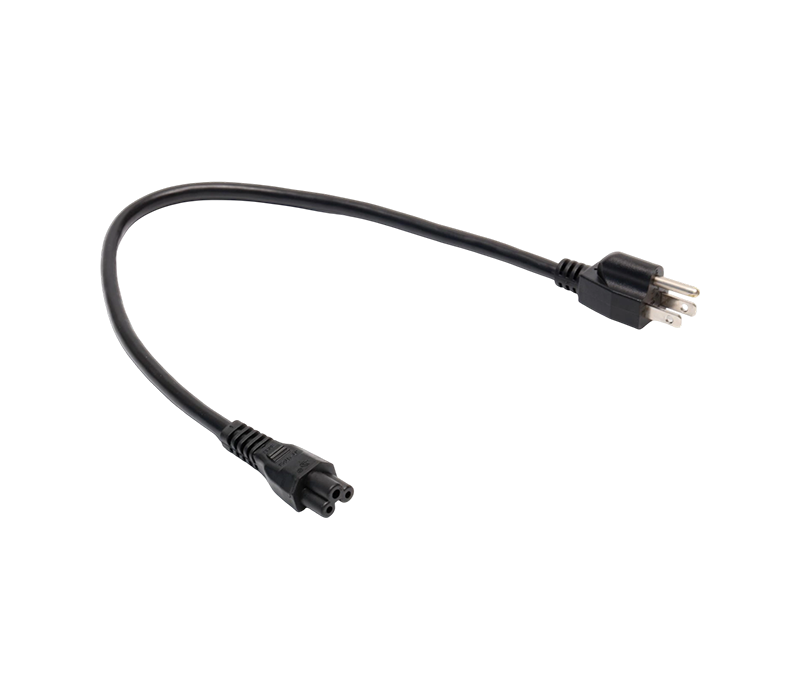
The 3-pin high-voltage male female connector is one of the most common configurations in residential and light-commercial LED systems. It is rated for line-voltage installations and uses a locking housing that keeps the two halves from separating under vibration, which is the type of detail worth asking about before you order.
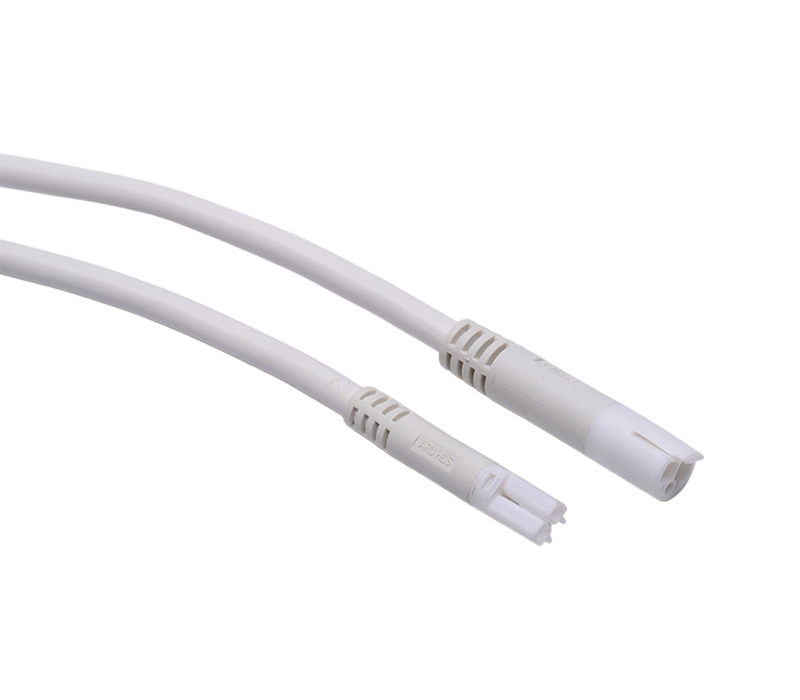 3-Pin High-Voltage Male/Female Connector for Line-Voltage LED SystemsRated for 5A 250V AC and compatible with H03/05VV-F 3G 0.75mm² wires, this locking connector ensures stable, safe power transmission in residential and industrial high-voltage circuits.View Product →
Low Voltage vs High Voltage: The First Safety Decision
Voltage class decides insulation thickness, connector housing, and the installation code that applies. Low-voltage harnesses, usually 12V or 24V DC, are common in cabinet lights, mirror fronts, and decorative strips. They are safer to handle and do not require an electrician in most regions. High-voltage harnesses run at line voltage, 110V or 230V AC depending on the market. They need higher creepage distances, flame-retardant housings, and often a locking mechanism to prevent accidental unplugging.
A small low-voltage connector is appropriate when everything after the driver is 12V or 24V. These harnesses are more forgiving of minor moisture and can be used in damp indoor locations with a basic IP44 housing.
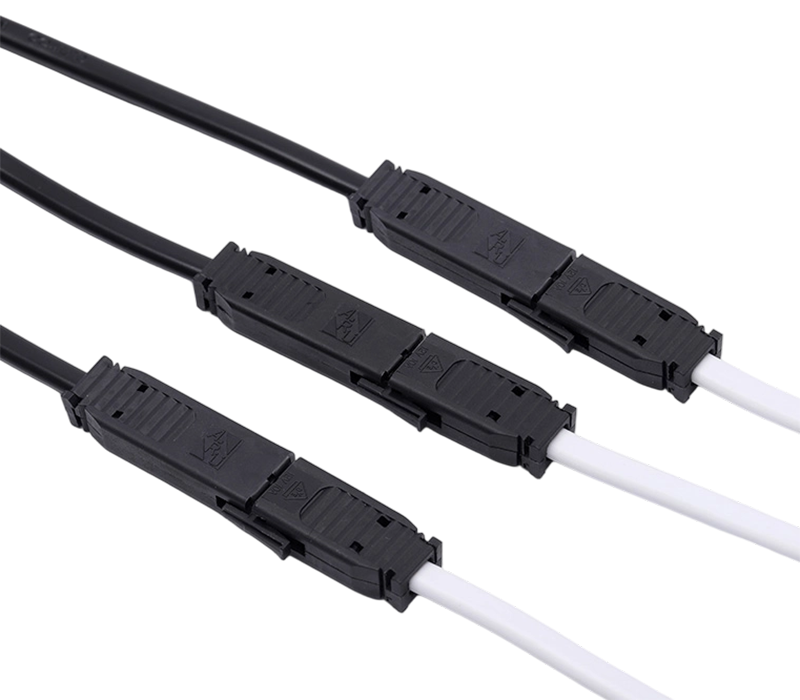 Small Low-Voltage Connector for 12V DC ApplicationsThis 10A 12V DC connector with VDE certification is suitable for low-voltage cabinets and mirrors, offering reliable connections for high-current low-voltage devices in damp indoor environments.View Product →
IP Ratings and Outdoor Use
IP stands for Ingress Protection. The first digit covers solid particles. The second digit covers water. IP67 means total dust protection and protection against temporary immersion. For LED connector harnesses used outdoors, that is the level that survives rain, sprinkler spray, and the occasional flood. An IP44 connector can handle splashing water but not standing water, and is best used in a covered exterior location.
An IP67 male female Y-shaped connector splits one cable into two branches while maintaining the seal. This is what you see in garden string lights and pathway installations that need to fan out from a single power point. For line-voltage outdoor runs, always confirm that the connector housing is UV stabilized as well as waterproof.
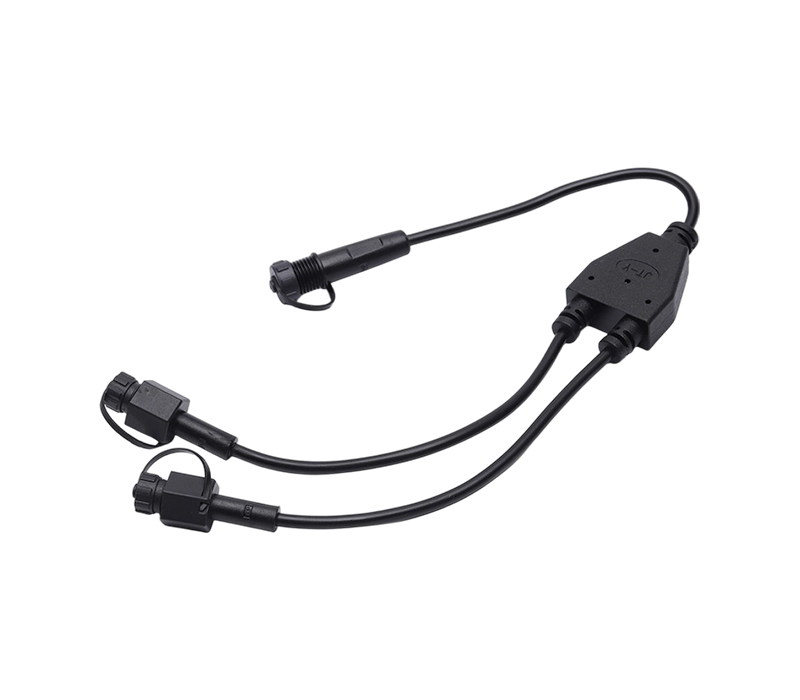 IP67 Male/Female Y-Shaped Connector for Outdoor LightingWith an IP67 rating and 3A 12/48V DC specification, this Y-shaped connector splits one cable into two branches while maintaining a waterproof seal, ideal for garden and pathway lighting.View Product →
What to Look for When Sourcing from a Supplier
Price per unit is only half the story. Ask about the wire type: UL or CE rated, copper vs copper-clad aluminum. Ask about the crimp process. A good supplier will give a pull-out force specification. Ask about connector retention. A harness that can be pulled apart under 5 kg of force is a maintenance liability. Ask about the molding material. Polycarbonate or nylon 66 with a flame retardant rating of V-0 is standard for high-voltage parts.
The manufacturer behind the product matters almost as much as the product itself. A supplier that works to international standards and has a structured quality system will produce more consistent terminations. The top benefits of using an LED connector harness in wiring all point back to this consistency: fewer field failures, less rework, and a cleaner end product.
You should also check whether the supplier can produce custom lengths. Standard harnesses come in 15 cm, 30 cm, 50 cm, and 1 m, but lighting layouts are rarely perfectly standard. A supplier that contracts a custom cable and terminates it to your drawing will save you from field modifications.
Useful Questions Before Placing an Order
- What is the rated current at the operating temperature?
- What is the pull-out force of the terminated pins?
- Is the connector housing flame retardant and UV stabilized?
- Can you supply a sample batch for a pilot run before full production?
- What is the lead time for a custom length and pin configuration?
These are the questions that separate a component supplier from a partner who understands your application. If the answers are vague, the harness will be vague too.
A harness that matches the environment, voltage, and control requirement will save money in every phase of the lighting project. Start with the environment, then find the pin count, lock the voltage class, verify the IP rating, and check the supplier quality data. This sequence will keep you from repeating the failure story at the top of this article.
If you need help matching an LED connector harness to your lighting project, contact our team and share your drawings.
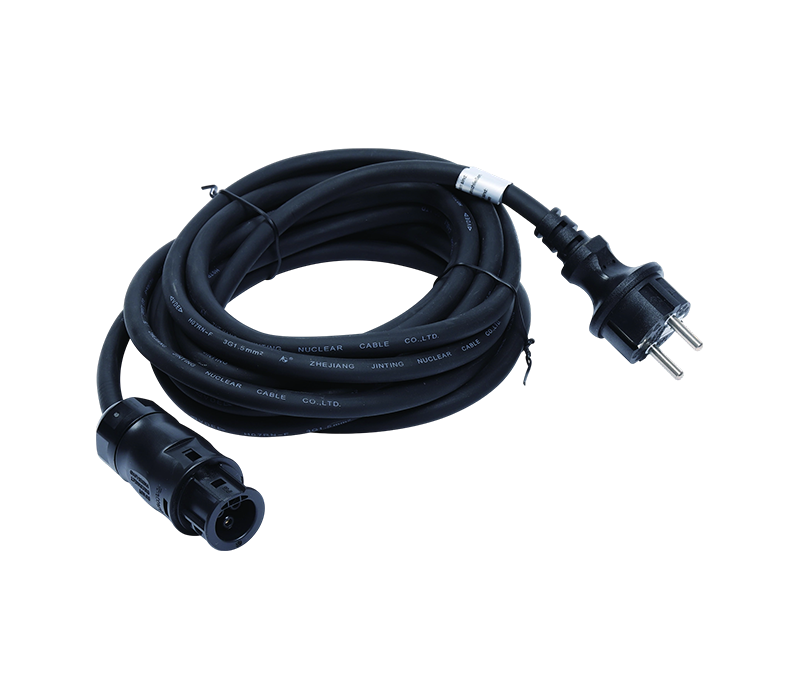
Latest News
Contact Us
LET'S START COLLABORATING
 Ningbo TOP Electromechanical Co., Ltd.
specializes in the R&D and manufacturing of
wires & cables, plugs & sockets, waterproof LED connectors, and more. Ourproducts
meet multiple international certifications and are widely used in global markets.
Ningbo TOP Electromechanical Co., Ltd.
specializes in the R&D and manufacturing of
wires & cables, plugs & sockets, waterproof LED connectors, and more. Ourproducts
meet multiple international certifications and are widely used in global markets.
STAY CONNECTED
 Phone:+86-13586690829
Tel:+86-0574-62135837-801
 [email protected]
[email protected]
 Sibei Industrial Yuyao City, Ningbo, Zhejiang, China
MOBILE
Copyright © Ningbo TOP Electromechanical Co., Ltd. All Rights
Reserved
 Custom Electrical Power Cord Manufacturers