


 中文简体
中文简体  Español
Custom Length Power Cords: The Complete Buying Guide for Exact Cable Runs
 2026.08.20
 Industry News
In many builds, the longest time delay comes from an unexpected problem: the standard power cord is either too short to reach the outlet or so long that it creates loops of cable that collect dust and block airflow. Custom length power cords solve that problem by giving you a cable cut, stripped, and terminated to match your installation.
Why the Right Cable Length Matters
Choosing the correct cable length is not about neatness alone. An oversized power cord introduces excess material, adds weight to cable trays, and increases the risk of tangling or accidental pulling. On the other hand, a cord that is too short forces you to rely on extension adapters or relocation of the outlet, both of which add cost and failure points.
From an engineering perspective, exact lengths improve reliability. Shorter, correctly routed cables reduce mechanical stress on connectors and keep excess cable away from heat sources. For a machine builder, a custom length also simplifies final inspection: every unit ships with a cord that fits the layout exactly, with no need to bundle extra wire.
Key Specifications for Custom Power Cords
To define a custom power cord properly, you need more than a length figure. The main parameters are wire gauge, current rating, plug configuration, connector type, and insulation material. The gauge is usually selected to match the load and cord length, with thicker wire used for longer runs or higher currents. Common choices are 18 AWG for indoor appliance loads up to 10 A, 16 AWG for 13 A cords, and 14 AWG for 15 A or 20 A applications. Although voltage drop is rarely an issue at 2 to 3 m, a 10 m cord can show a measurable voltage drop under high current; when ordering longer cords, you may need to step up one gauge size to stay within the terminal voltage rating of the device.
Voltage and frequency also dictate the cord design. A 125 V rated cord intended for the North American market will not meet the requirements of a 230 V European installation. This is why manufacturers require the target country or region before production. The table below summarizes common regional standards.
| Plug standard | Typical ratings | Primary markets |
|---|---|---|
| NEMA 5-15 | 15 A / 125 V | North America, Japan |
| CEE 7/7 | 16 A / 250 V | Most of Europe |
| BS 1363 | 13 A / 250 V | UK, Ireland, Malaysia |
| AS/NZS 3112 | 10 A / 15 A / 250 V | Australia, New Zealand |
| IEC 60320 | Depends on configuration | Device inlets worldwide |
For equipment that plugs into an IEC inlet, the device-side connector is just as important as the mains plug. An IEC C13 connector socket is the most common choice for computers, monitors, and small appliances, while C19 and C20 serve high-current equipment.
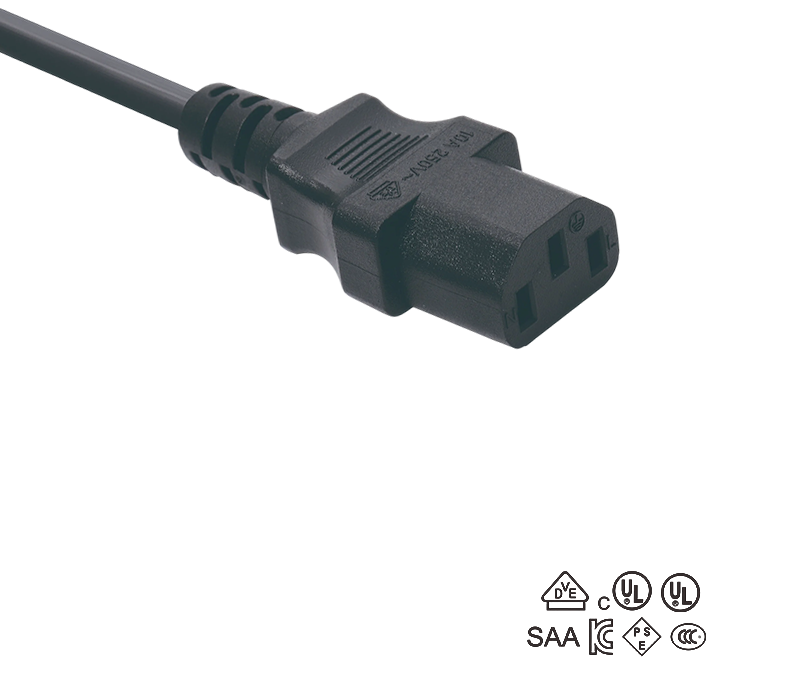 Wholesale JT-ST3 IEC Connector Female Socket C13 For Universal Standards FactoryNingbo TOP Electromechanical Co., Ltd is China wholesale JT-ST3 IEC Connector Female Socket C13 For Universal Standards suppliers and JT-...View Product →
In addition to the plug and connector, the cable itself must meet the temperature rating of the application. PVC cords are common for indoor equipment at 60°C or 70°C, while thermoplastic elastomer (TPE) jackets provide better flexibility at low temperatures. If the cord will be used outdoors or in a hot enclosure, the jacket material and thickness must match the environment. These details are part of the specification that a custom manufacturing partner can confirm.
How to Determine the Exact Length You Need
Start by measuring the physical route from the wall outlet to the equipment inlet, including any bends through cable trays, conduit, or rack channels. Add a service loop of 10 to 15 percent to allow for minor repositioning. For equipment that slides in and out of a rack, add an extra 0.5 to 1 metre so the cord does not pull the connector loose when the tray is extended.
If the cord will be visible, take the time to decide whether you want a straight or right-angle plug. A right-angle plug can reduce the clearance needed behind a device and help the cord hug the wall. The same logic applies to the device-side connector; a right-angle C13 plug is useful in tight server racks. Also consider the bend radius of the cable. A stiff cord may need more clearance around corners, while a soft silicone jacket will follow tight paths without straining the plug.
Applications That Benefit Most from Custom Lengths
The best candidates for custom cords are installations where standard lengths create visible cable loops or cannot span the distance between outlet and device. Data centers and server rooms are obvious beneficiaries: shorter cords reduce the thickness of cable bundles in vertical cable managers and improve airflow through racks. Industrial control panels benefit because wires can be routed precisely away from moving parts and heat sources.
LED lighting systems are another important application. A lighting manufacturer may need a paired cord and connector that matches a specific mounting height or spacing between fixtures. In that case, a 15 A 125 V US standard three-pin cord can be cut to the exact drop length, while a European project might use a 16 A 250 V European standard two-pin cord to serve a similar installation. Custom lengths eliminate junction boxes and extra adapters, which reduces failure points and assembly time.
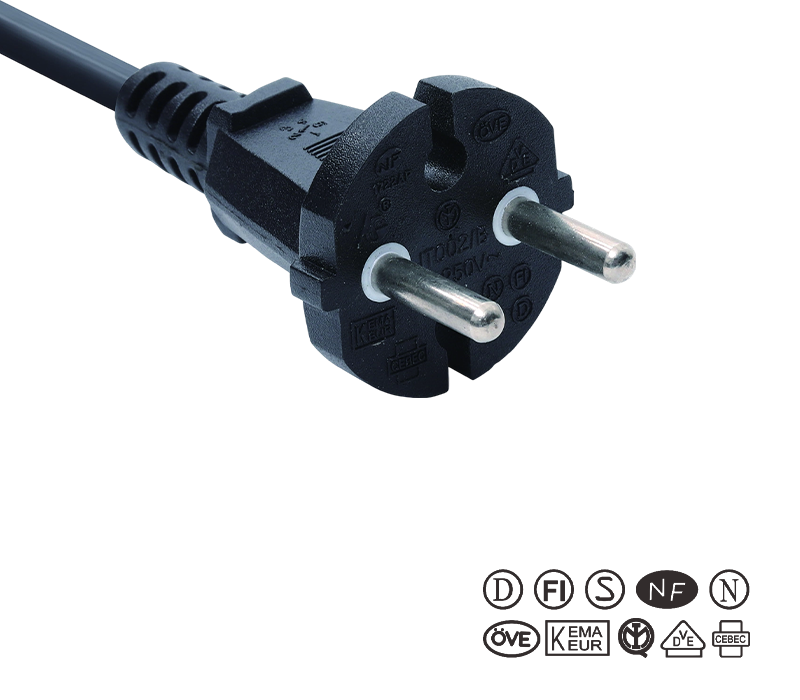 Wholesale JT002/B/FY002 16A 250V European Standard Two-Pin Tool Plug Factory, SuNingbo TOP Electromechanical Co., Ltd is China wholesale JT002/B/FY002 16A 250V European Standard Two-Pin Tool Plug suppliers and JT002/B...View Product →
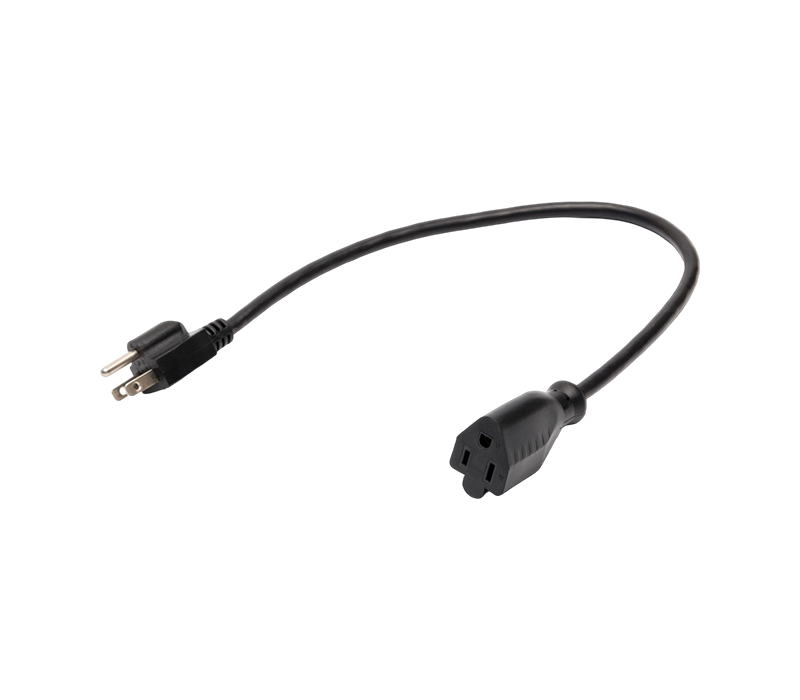 Wholesale JT-3/FY-3+JT-3Z 15A 125V American Standard Three-Pin Plug with Female Ningbo TOP Electromechanical Co., Ltd is China wholesale JT-3/FY-3+JT-3Z 15A 125V American Standard Three-Pin Plug with Female Socket sup...View Product →
Working with a Power Cord Manufacturer
When you order custom power cords, treat it as a managed assembly rather than a simple cut-to-length process. You need to supply the plug standard, cable length, wire gauge, connector type, jacket color, and any required certifications. A good manufacturer will confirm these details before production and send a pre-production sample for your approval. A typical custom cord request should include:
- Target market and plug standard
- Wire gauge and conductor count
- Exact length in metres or feet
- Connector type on the device end (if any)
- Cable colour and jacket material
- Certifications or compliance marks required
Quality control is non-negotiable for safety components. Ask how continuity, polarity, and dielectric strength are tested on every lot. A reputable manufacturer will provide test reports and support your certification filing with the relevant documentation.
Minimum order quantities are often lower than people expect. Many manufacturers will accept a few hundred pieces for a first production run, especially if the cord uses a standard plug and a common wire gauge. Confirm the MOQ and lead time before the design is finalised.
Delivery reliability is the final factor. Look for a maker with access to major ports and a flexible production line that can handle mixed specifications. If you are ready to discuss your project, contact our team with your target market and lengths, or review the power cord ranges we produce for reference.
Custom length power cords are a simple yet effective way to reduce clutter, improve safety, and speed up installation. By defining the plug standard, conductor gauge, connector type, and exact length, you remove uncertainty from the final build. Work with a manufacturer that can confirm certification and deliver consistent quality, and the rest of your assembly line can keep moving.
Latest News

Contact Us
LET'S START COLLABORATING
 Ningbo TOP Electromechanical Co., Ltd.
specializes in the R&D and manufacturing of
wires & cables, plugs & sockets, waterproof LED connectors, and more. Ourproducts
meet multiple international certifications and are widely used in global markets.
Ningbo TOP Electromechanical Co., Ltd.
specializes in the R&D and manufacturing of
wires & cables, plugs & sockets, waterproof LED connectors, and more. Ourproducts
meet multiple international certifications and are widely used in global markets.
STAY CONNECTED
 Phone:+86-13586690829
Tel:+86-0574-62135837-801
 [email protected]
[email protected]
 Sibei Industrial Yuyao City, Ningbo, Zhejiang, China
MOBILE
Copyright © Ningbo TOP Electromechanical Co., Ltd. All Rights
Reserved
 Custom Electrical Power Cord Manufacturers