


 中文简体
中文简体  Español
Heavy-Duty Power Cord Supplier | Custom Length Power Cords Wholesale
 2026.08.13
 Industry News
What Is a Heavy-Duty Power Cord and When Do You Need One?
When procurement teams search for a heavy-duty power cord supplier, they are not looking for a spare cable. They are looking for a manufacturing partner that can deliver the right gauge, ampacity, plug configuration, and compliance documents for products sold in multiple countries. The same logic applies when the order is for custom length power cords wholesale: the cord becomes part of a bill of materials, not an afterthought.
A heavy-duty power cord is defined by continuous current rating, conductor cross-section, voltage rating, and jacket durability. In practical terms, the wire gauge is usually 16 AWG, 14 AWG, or 12 AWG; the current rating is typically 15A or 16A, with 20A versions for higher-load equipment; and the voltage rating is normally 125V or 250V. The jacket material matters too, with PVC common for indoor equipment and rubber or TPE used where flexibility, cold resistance, or abrasion resistance is more important.
These cords show up in industrial machines, commercial cooking equipment, server and network cabinets, medical devices, power tools, and outdoor appliances. Undersizing a cord is not just a performance problem; it is a fire hazard. A 20A motor or an electric heater on a 10A cord can overheat the contacts and insulation long before the fuse opens. That is why reliable suppliers treat current rating and conductor material as non-negotiable specifications.
Before you evaluate a supplier, define the environment where the cord will be used. Is it fixed or flexing? Indoor or outdoor? Exposed to oil or water? Then match those conditions to a cord family. If you need a broad reference, browse the heavy-duty power cord product range to see how manufacturers organize cords by current rating and plug standard.
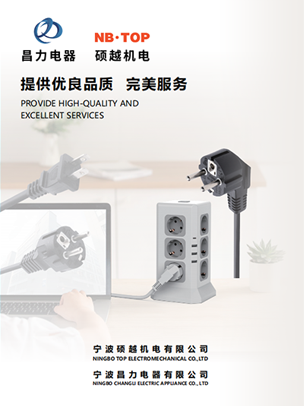 OEM/ODM Heavy-Duty Power Cord Factory, ManufacturersNingbo TOP Electromechanical Co., Ltd. is China power cord manufacturers and OEM/ODM heavy-duty power cord suppliers. We are a factory th...View Product →
Key Criteria for Evaluating a Heavy-Duty Power Cord Supplier
Not every supplier that calls itself a heavy-duty power cord supplier can back up the label. The checks below separate order-takers from actual manufacturers.
Certification coverage. The supplier must hold valid product certifications for the target market: UL or CSA for North America, CE for the European Economic Area, VDE for Germany, SAA for Australia, PSE for Japan, and KC for South Korea. Ask for the certificate file, not just a logo on the homepage. Then check the certificate number against the certifying body’s database. If the supplier stalls, that is a clear warning.
Manufacturing entity versus trader. A manufacturing entity owns production lines, injection molding machines, testing fixtures, and in-house quality staff. A trader can only coordinate paperwork. For custom lengths and custom connectors, the factory is the one that solves problems. A manufacturer in Yuyao, Zhejiang, for example, can show production and testing capabilities on site. You can learn more about our manufacturing capabilities to understand the difference.
Quality system. Ask how the supplier handles incoming conductor and plug material inspection, in-process checks during molding and assembly, and final testing before packing. AQL sampling plans are common for batch orders, but the sample size and defect levels should be clear.
Multi-standard coverage. If your product line ships to North America, Europe, the UK, and Australia, a supplier that builds cords for all those standards simplifies purchasing, reduces freight, and makes first-article inspection faster.
Location and logistics. A factory near an international port or airport shortens lead times and makes urgent revisions easier. Yuyao’s proximity to Ningbo Port and Hangzhou International Airport is a practical advantage for sea freight to North America and Europe.
Red Flags to Avoid When Vetting Suppliers
Watch for these signals: certificates that cannot be shared, a factory address that turns out to be an office, a MOQ that changes after sampling, a price per unit far below copper-cost benchmarks, and slow technical answers to questions about gauge, plugs, or tolerances. Any one of these is enough to request a sample and run your own test before committing to wholesale volumes.
Why Custom Length Power Cords Matter for Wholesale Buyers
For wholesale buyers, custom length power cords are a cost-control tool, not just a convenience. When you order 1.2m instead of a standard 1.8m or 3m, you reduce copper, PVC, packaging, and shipping weight. You also reduce the amount of coiled cable inside a control cabinet or behind a medical cart, which improves airflow and reduces the risk of people tripping over loops.
Custom length also solves mechanical problems. A 90-degree plug saves vertical space behind a refrigerator or a server rack. A wire clamp relieves strain on the cable entry point. A fuse in the plug protects the connected load in some jurisdictions. Waterproof plugs protect outdoor equipment. When the length is paired with these options, the cord becomes part of the product design rather than an off-the-shelf compromise.
What to Specify When Ordering Custom Length Power Cords
Give the supplier a complete specification sheet. At minimum, include:
- Cord length and tolerance. ±50 mm is a common production tolerance, but confirm the acceptable range for your device.
- Wire gauge and conductor material. Specify pure copper or copper-clad aluminum. CCA can save cost, but it is not appropriate for every high-current application.
- Plug standard and geometry. Straight, 90-degree angled, with fuse, with wire clamp, or waterproof.
- Appliance-side connection. IEC C13/C14/C15/C19, stripped leads, ring terminals, or hard wiring. For rack-mounted equipment, check whether a 90-degree angled C13 connector
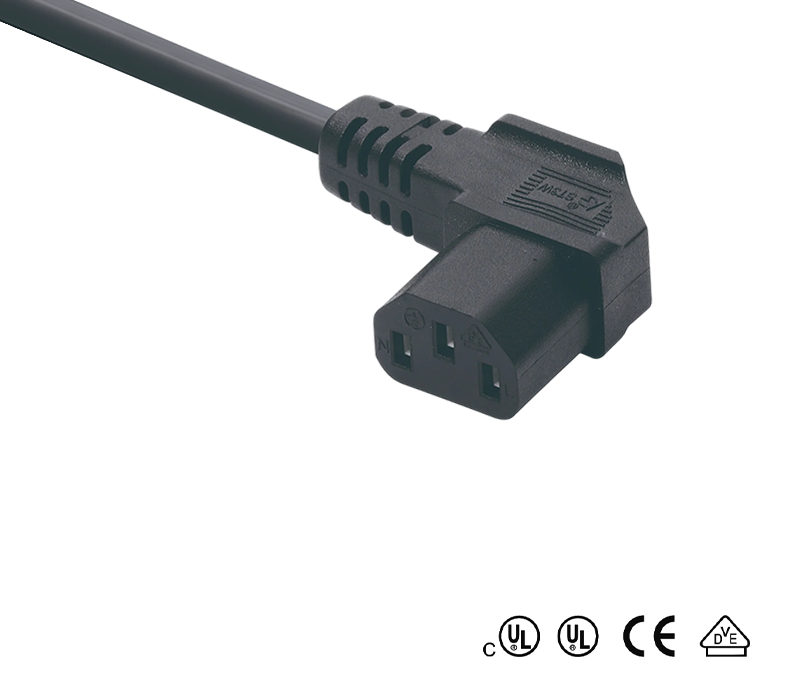 Wholesale ST3W IEC Connector 90-Degree Angled Female Socket C13 Complying With UNingbo TOP Electromechanical Co., Ltd is China wholesale ST3W IEC Connector 90-Degree Angled Female Socket C13 Complying With US, Chinese...View Product → fits the inlet.
 - Rated current and voltage. Based on the device load and the end-market supply.
- Jacket material and color. For branding, UV resistance, or chemical exposure.
- Logo or label requirements. Molded plugs can carry logos, and cable labels can carry certification marks or part numbers.
- Required certifications. List every destination market.
Understanding Global Plug Standards for Heavy-Duty Power Cords
If you sell to more than one country, plug standards are not a minor detail. The same device may need different plugs for North America, Europe, and the UK. The table below summarizes the most common heavy-duty configurations.
| Market | Plug Standard | Typical Rating | Notes |
|---|---|---|---|
| North America | NEMA 5-15P / 5-20P | 15A / 20A at 125V | 5-20P is used for higher-load equipment such as servers and commercial appliances. |
| Europe | CEE 7/7 | 16A at 250V | Grounded and widely accepted across continental Europe. |
| United Kingdom | BS 1363 | 13A at 250V | Fused plug required; common current rating is 13A. |
| Australia / New Zealand | AS/NZS 3112 | 10A / 16A at 250V | Flat pins with a distinctive angled ground pin. |
| Japan | JIS C 8303 | 15A at 125V | Similar to NEMA but with slightly different housing dimensions. |
North America uses NEMA 5-15P at 15A 125V and NEMA 5-20P at 20A 125V. If you need the higher-current version, the 20A 125V high-current NEMA plug is a practical example of what a heavy-duty cord can carry.
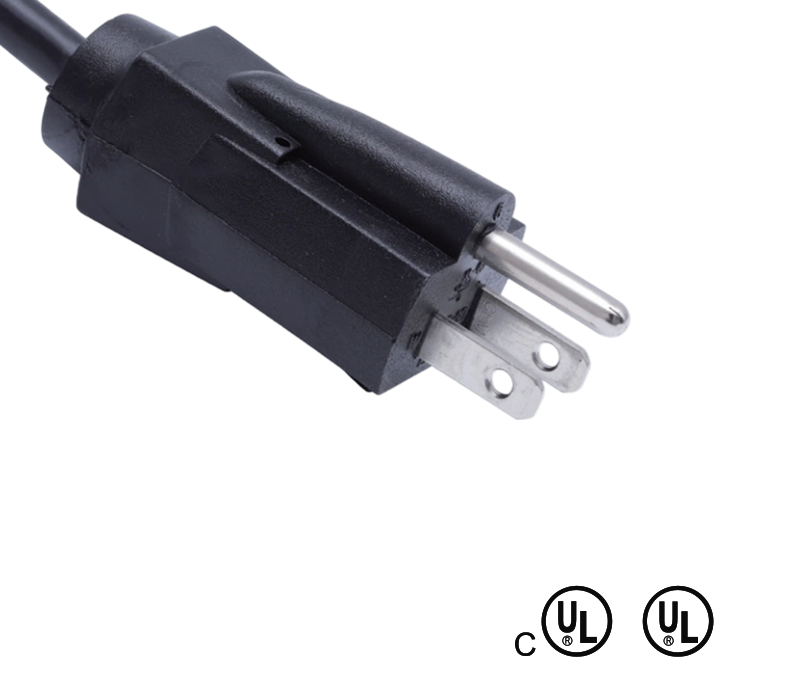 Wholesale JT-3D 20A 125V High-Current Three-Pin American Standard Plug Factory, Ningbo TOP Electromechanical Co., Ltd is China wholesale JT-3D 20A 125V High-Current Three-Pin American Standard Plug suppliers and JT-3D...View Product →
Most European orders use CEE 7/7; see European standard power cords for typical 16A 250V configurations. UK-bound equipment requires a fused BS 1363 plug; the BS 1363 UK power cords page covers 13A versions. Australia and New Zealand use AS/NZS 3112; Australian standard power cords are available in 10A and 16A. Japan uses JIS C 8303; Japanese standard power cords are rated at 15A 125V.
Because voltage and frequency differ by country, the wire gauge and current rating must be rechecked for each destination. A cord designed for 125V North America may not have the same thermal margin when used at 250V in Europe, even if the plug shape is different.
The Wholesale Ordering Process: From Inquiry to Delivery
Once you shortlist a supplier, the ordering process follows a predictable sequence. The strength of each step determines whether the production run meets your expectations.
- Requirement communication. Share the device, target markets, estimated annual volume, and the certification list. The more precise the load current and physical constraints, the more useful the quote.
- Sampling. Request pre-production samples. Test insertion and extraction force, connector seating, temperature rise under load, withstand voltage, cord length within tolerance, and the mechanical fit with your enclosure.
- Mass production and quality control. Confirm how the factory will conduct in-process inspection and final inspection. Agree on AQL levels, defect classification, and what to do when a batch fails.
- Delivery. Agree on MOQ, production lead time, packaging, and trade terms. A supplier near Ningbo Port can consolidate sea freight more easily than one far inland.
If you want a current view of MOQ and lead times, contact our sales team with your specifications. It is also worth checking whether the supplier has a custom service section or a dedicated engineering contact who can review your drawing before production.
Conclusion: Building a Long-Term Partnership with the Right Supplier
Selecting a heavy-duty power cord supplier is really a risk management decision. The six criteria that matter at wholesale level are certification documentation, factory ownership, quality systems, multi-standard coverage, customization depth, and logistics reliability. A supplier that scores well on all six makes your supply chain simpler.
Custom length power cords wholesale becomes easier when the supplier can cut, strip, terminate, mold, and test in-house. That is the difference between a catalog and a manufacturing partnership. Start with the product pages that match your target market, then send your specification sheet for a quote. The right supplier will ask the right questions before offering a price.
Latest News

Contact Us
LET'S START COLLABORATING
 Ningbo TOP Electromechanical Co., Ltd.
specializes in the R&D and manufacturing of
wires & cables, plugs & sockets, waterproof LED connectors, and more. Ourproducts
meet multiple international certifications and are widely used in global markets.
Ningbo TOP Electromechanical Co., Ltd.
specializes in the R&D and manufacturing of
wires & cables, plugs & sockets, waterproof LED connectors, and more. Ourproducts
meet multiple international certifications and are widely used in global markets.
STAY CONNECTED
 Phone:+86-13586690829
Tel:+86-0574-62135837-801
 [email protected]
[email protected]
 Sibei Industrial Yuyao City, Ningbo, Zhejiang, China
MOBILE
Copyright © Ningbo TOP Electromechanical Co., Ltd. All Rights
Reserved
 Custom Electrical Power Cord Manufacturers