


 中文简体
中文简体  Español
Electrical Power Cord: Types, Standards, and How to Choose the Right One
 2026.09.17
 Industry News
A shipment of 2,400 electrical power cords arrives at your warehouse two weeks before a product launch. The plugs match the destination market's socket geometry, the cables bend easily, and the quoted price was excellent. Then lab testing shows that the conductors are thinner than the 18 AWG specified in the purchase order, and the cord jacket temperature climbs 25°C above the acceptable limit at the appliance's rated current. The batch is quarantined, the launch is delayed, and the discount negotiated with the supplier evaporates in overtime production costs.
That scenario repeats more often than buyers like to admit, and it explains why the electrical power cord — a part frequently treated as a commodity — deserves the same engineering attention as the device it feeds. Understanding how power cords are classified, rated, and certified is the fastest way to keep a project on schedule.
What an Electrical Power Cord Actually Is
An electrical power cord, also called a line cord, mains cable, or power lead, is a flexible cable assembly that connects an appliance to the mains electricity supply through a wall socket. It is a simple product in appearance and a precise product in construction: it must match the socket standard of the market, deliver the rated current without overheating, and supply the correct voltage to the device.
Every power cord is built from the same three functional parts:
- Plug (male end) — inserted into a wall socket; plug shape, pin dimensions, and grounding contact must match the national standard of the destination country.
- Cable — flexible conductors with insulation and an outer jacket; conductor cross-section, insulation temperature rating, and jacket material determine current-carrying capacity and durability.
- Connector or termination (female end) — the interface to the appliance, either an IEC 60320 connector, a proprietary socket, or stripped and tinned wires for internal connection.
When you specify a power cord, you are making three linked decisions: which plug standard, which cable construction, and which termination type. The sections below explain each one in practical terms.
Regional Plug Standards Set the Hard Limit
The first decision is the plug. There is no universal plug standard: each region uses sockets with different shapes, pin sizes, and grounding arrangements, and a cord made for one market will not fit another without modifications.
| Region | Standard / Plug Type | Typical Rating |
|---|---|---|
| North America (USA, Canada) | NEMA 1-15, NEMA 5-15 | 15 A, 125 V |
| Europe (most EU countries) | CEE 7/16 Europlug; CEE 7/7 (Schuko) | 2.5–16 A, 250 V |
| United Kingdom | BS 1363 (fused three-prong) | 13 A, 250 V |
| Australia / New Zealand | AS/NZS 3112 | 10–15 A, 250 V |
| China | GB 2099 | 10–16 A, 250 V |
| Japan | JIS C 8303 | 15 A, 125 V |
| Korea | KSC 8305 | 16 A, 250 V |
| Brazil | NBR 14136 | 10–20 A, 250 V |
| South Africa | SANS 164-1 | 16 A, 250 V |
| Switzerland | SEV 1011 (Type J) | 10–16 A, 250 V |
For North America, most 120 V appliances use the NEMA 5-15 plug, a two-pole, three-wire grounding design with two flat blades of different widths and a U-shaped ground pin. The asymmetric blade layout prevents reversed insertion. Right-angle versions of the same plug fit recessed outlets and tight spaces behind appliances.
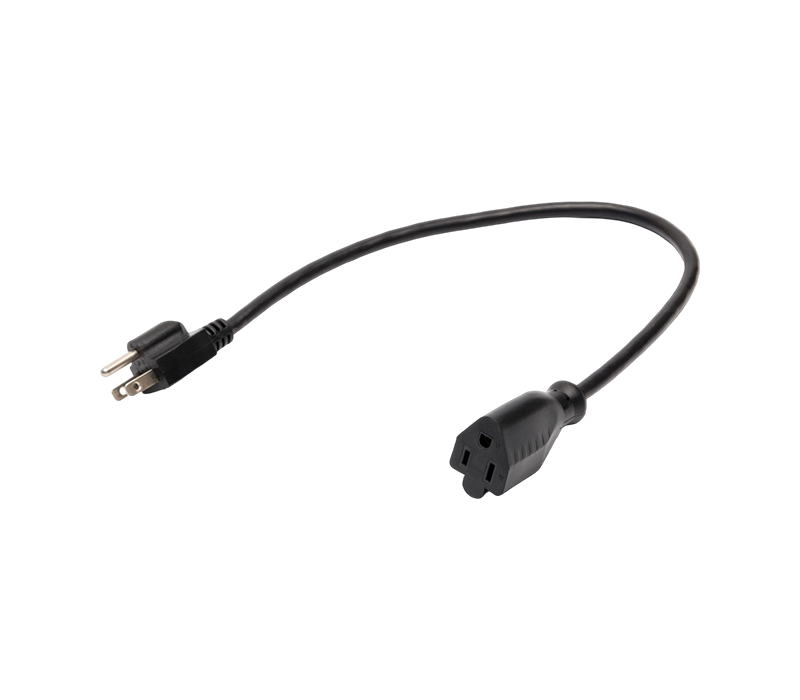 15A 125V American Three-Pin Plug with Built-In Female SocketThis North American plug combines a NEMA-style grounding plug with a pass-through female outlet, enabling direct power connection and multi-device extension. It fits standard 120 V household sockets and suits setups needing easy power distribution.View Product →
On the 220–240 V side, the CEE 7/7 Schuko plug with side grounding clips covers most of Europe at up to 16 A, while the flat CEE 7/16 Europlug (2.5 A) fits the same sockets for low-current devices. Plug orientation also matters for enclosure design and market preferences.
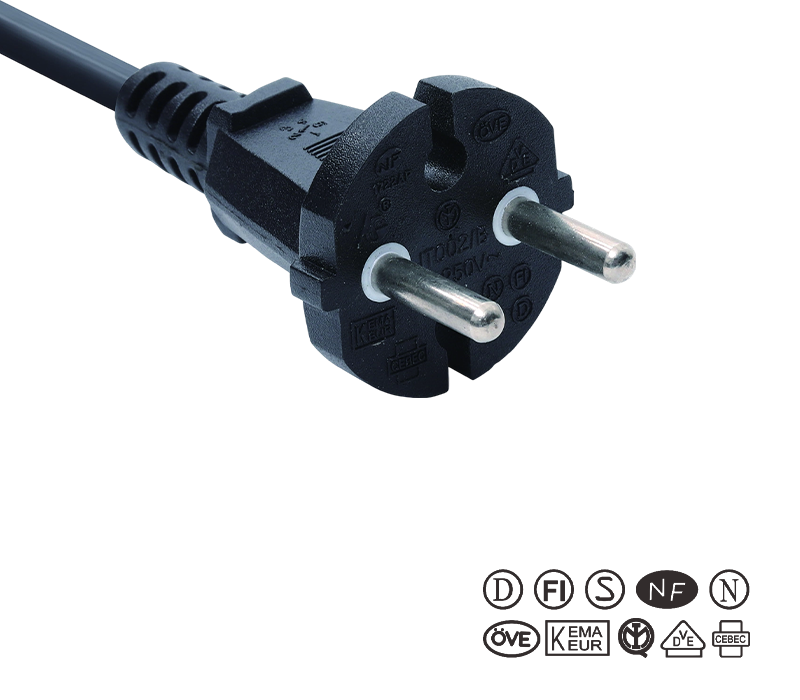 16A 250V European Two-Pin Heavy-Duty Tool PlugRated for high-power tools like drills and saws, this two-pin plug has reinforced prongs to resist bending under frequent use. It meets European standards and is built for demanding job sites and workshops.View Product →
Other destination markets — including Argentina, Israel, Italy, Denmark, Thailand, and Taiwan — use their own plug geometries, so confirm the plug type for each country before finalizing a specification. For a closer look at plug construction and internal connections, see this guide on what a plug is.
Electrical Ratings: Voltage, Current, and Cable Markings
The plug determines whether the cord physically fits the outlet. The electrical rating determines whether it can do the job safely.
Voltage rating matters for insulation: a cord rated 125 V is designed for 100–120 V grids, while a 250 V rating is required for 220–240 V networks. The insulation and plug materials must tolerate the system voltage with adequate safety margin.
Current rating, or ampacity, is governed mainly by the conductor cross-section. Larger conductors carry more current with less heat. The table below lists typical ampacities for common flexible cord sizes.
| Conductor Size (AWG) | Cross-section (mm²) | Typical Ampacity |
|---|---|---|
| 18 AWG | 0.82 | 10 A |
| 16 AWG | 1.31 | 13 A |
| 14 AWG | 2.08 | 15 A |
| 12 AWG | 3.31 | 20 A |
These figures assume typical PVC insulation, multiple conductors in a cord, and a 30°C ambient environment; the applicable cable standard may specify different values.
Learn to read the markings printed on the cord jacket. A North American cord marked SVT 18 AWG 3C 125V 10A tells you the jacket style, conductor gauge, number of conductors, voltage, and current rating. A European cord marked H05VV-F 3G1.0 is a harmonized PVC-sheathed flexible cord with three 1.0 mm² conductors rated 300/500 V. These markings are the easiest way to verify that you received the exact grade you ordered.
Cord length affects performance as well. Every extra meter adds resistance and voltage drop, so a long cord on a high-current appliance should use a larger conductor to keep the voltage at the appliance within specification.
Insulation material is the final rating factor. PVC is the default for indoor cords, rated from 60°C to 105°C depending on grade. Rubber and silicone jackets handle higher temperatures and stay flexible in cold weather, so they appear on kettles, space heaters, and outdoor equipment.
Connector Types: The Interface Between Cord and Device
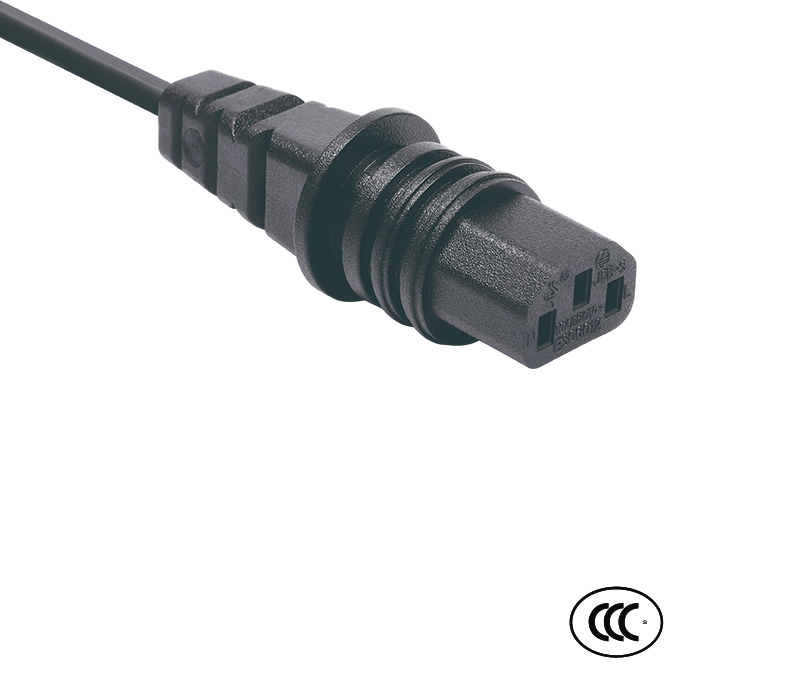
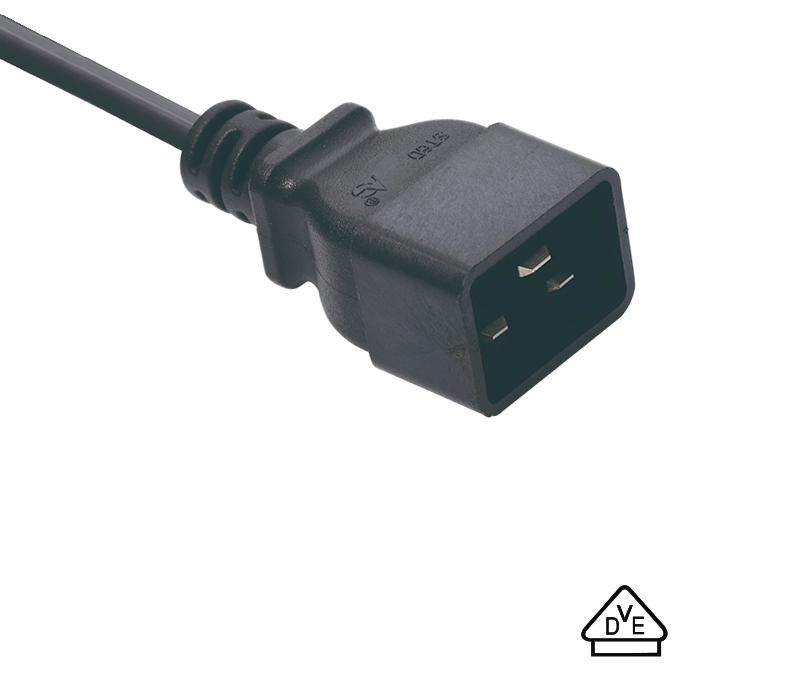
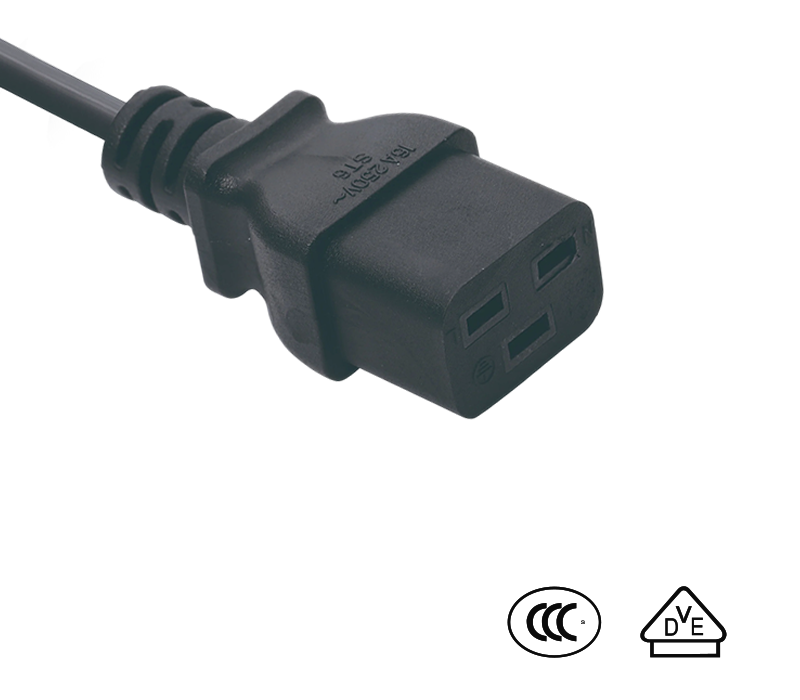
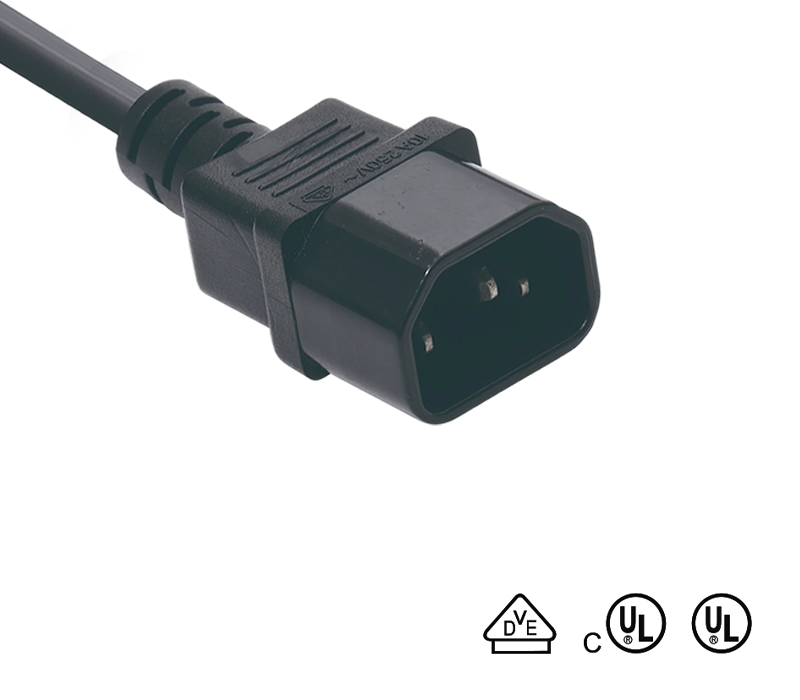
The third specification layer is the appliance-side connector. Most equipment with a detachable cord uses IEC 60320 connectors, an international standard family with distinct shapes and current ratings.
| Connector Pair | Common Name | Rated Current | Typical Use |
|---|---|---|---|
| C13 / C14 | Kettle plug and inlet | 10 A | Desktops, monitors, small appliances |
| C7 / C8 | Figure-8 | 2.5 A | Radios, battery chargers, small electronics |
| C5 / C6 | Mickey Mouse | 2.5 A | Laptop power adapters |
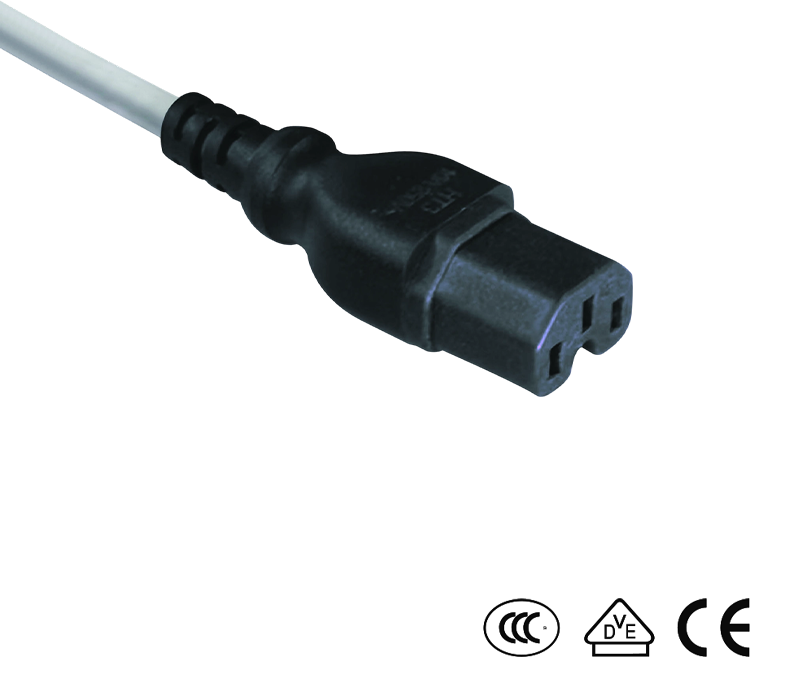
| C15 / C16 | High-temperature kettle | 10 A | Electric kettles, coffee machines |
| C19 / C20 | High-current locking | 16 A | Server racks, industrial equipment |
| C1 / C2 | Low-current two-pin | 1 A | Shavers, small chargers |
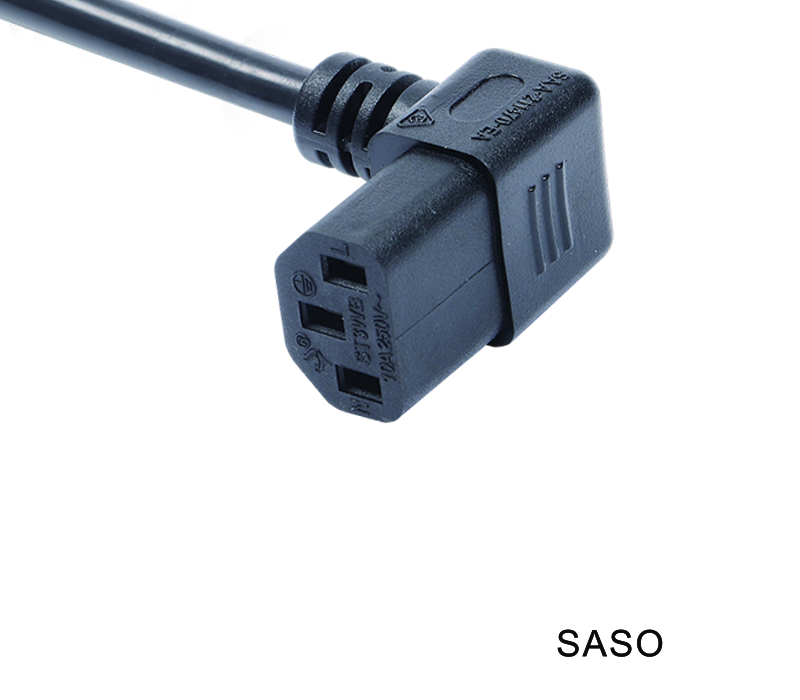
The C13/C14 pair is the most common for devices drawing up to 10 A. A 90-degree angled C13 socket is often specified for tight spaces behind desks or equipment racks because it keeps the cord footprint smaller than a straight connector and protects the cable from sharp bends.
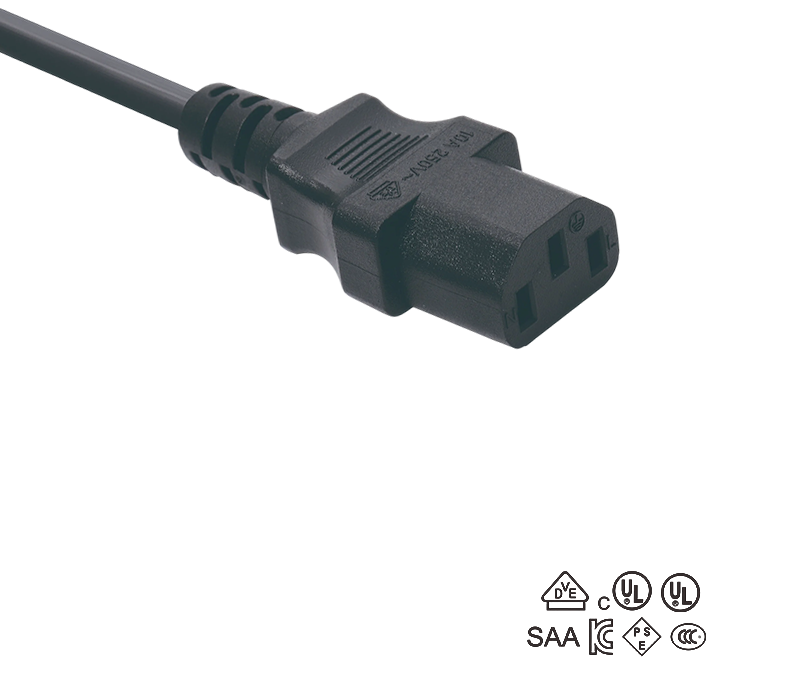 10A 250V IEC C13 Female Connector with Overload ProtectionThis C13 female connector provides reliable power to computers and monitors, featuring copper contacts and overload protection that cuts power to prevent equipment damage. Its universal compatibility makes it a flexible choice for home or office.View Product →
When the device does not use an IEC inlet, the cord can be terminated with stripped and tinned conductors, spade terminals, or a proprietary connector. In mass production, this termination is where most quality issues appear — poorly stripped conductors and weak solder joints are common field failures. Fixture-based termination and 100% continuity testing are worth asking your supplier about.
Certifications: A Non-Negotiable Checklist
A power cord requires a safety certification in the destination market before it can be imported, installed in a product, or sold through regulated distribution channels. Certification marks are not a marketing ornament; they are the documented evidence that a representative sample passed the applicable safety tests.
- North America: UL or cUL/CSA certification (or ETL) for the specific cord model.
- Europe: CE marking under the Low Voltage Directive, plus national marks where required.
- United Kingdom: UKCA or BS-approved products.
- Australia / New Zealand: RCM mark, backed by SAA approval.
- Japan: PSE mark, in the mandatory or voluntary category depending on the rating.
- Korea: KC mark.
- China: CCC mark for plugs and socket-outlets.
When a supplier shows you a certificate, check the model number and ratings printed on it. A certificate for one plug style does not cover other models in the catalog. This detail saves procurement teams from customs delays, failed audits, and product recalls.
What to Verify Before Ordering Custom Power Cords
OEM and ODM projects usually require custom power cords to some degree: length, colors, plug angle, fuse rating, or connector style. The following checks keep the process predictable.
Define the operating environment
Indoor, outdoor, wet, hot, industrial, or residential — each changes the insulation and jacket specification. Outdoor cords need weather-resistant jackets and, in many codes, a rated connector if the connection point is exposed. Do not order a standard PVC indoor cord for a garden lamp or a food-service counter.
Confirm the physical design
Cable length, plug angle, connector orientation, fuse inclusion, strain-relief design, and jacket color may look trivial until they slow down assembly or fail in the field. Attach a clear drawing with dimensions and request a pre-production sample before releasing the order for mass production.
Ask for test evidence
At minimum, request continuity testing, withstand voltage (hi-pot) testing, insulation resistance, and plug polarity. For production batches, ask about the manufacturer's sampling plan and whether rejected units are separated and re-inspected.
A supplier that builds cords across multiple standard families — as Ningbo TOP Electromechanical does with its American, European, British, Australian, Chinese, and IEC connector products — can consolidate validation documents, certifications, and testing in one place. Contact the manufacturer to discuss your application before finalizing the specification, and confirm the plan for samples and lead times.
The Takeaway
The electrical power cord is the critical link between your product and the grid. The specification logic is straightforward: plug for the market, conductor for the current, connector for the device, certificate for the regulator.
Start with a clear specification, read the markings on samples, and verify the certificates for every SKU. Then choose a manufacturer whose product range and quality controls match the markets you serve. For international OEM buyers, Ningbo TOP Electromechanical Co., Ltd. supplies power cords and IEC connectors across North American, European, British, Australian, Chinese, and Japanese standards, with custom lengths, plug angles, and terminations.
Latest News

Contact Us
LET'S START COLLABORATING
 Ningbo TOP Electromechanical Co., Ltd.
specializes in the R&D and manufacturing of
wires & cables, plugs & sockets, waterproof LED connectors, and more. Ourproducts
meet multiple international certifications and are widely used in global markets.
Ningbo TOP Electromechanical Co., Ltd.
specializes in the R&D and manufacturing of
wires & cables, plugs & sockets, waterproof LED connectors, and more. Ourproducts
meet multiple international certifications and are widely used in global markets.
STAY CONNECTED
 Phone:+86-13586690829
Tel:+86-0574-62135837-801
 [email protected]
[email protected]
 Sibei Industrial Yuyao City, Ningbo, Zhejiang, China
MOBILE
Copyright © Ningbo TOP Electromechanical Co., Ltd. All Rights
Reserved
 Custom Electrical Power Cord Manufacturers