


 中文简体
 Español

How to Choose a Power Cord Manufacturer: Standards, Safety, and Sourcing
 2026.10.15
 Industry News
Twenty thousand cord sets, one container, four retail SKUs, and a plug pin that measures half a millimetre too wide. That is the kind of detail that stops a shipment at the port, and it almost never comes from the copper inside the cable. It comes from a specification that nobody wrote down.
The short version: a power cord manufacturer earns its keep in three places. It matches plug geometry to each destination standard, matches conductor size to the real current and temperature, and proves both with test data before mass production starts. Unit price is the fourth question, not the first.
Match the Plug to the Market Before You Match the Price
A plug is a legal object, not a commodity. Every standard fixes pin spacing, pin diameter, sleeve length, blade orientation and, in some markets, a mandatory fuse. Two cords can look identical in a catalogue photo and still be non-compliant in each other's market. That is why the first line of a serious inquiry should name the destination country, not the target price.
| Market | Plug standard | Common rating | What decides approval |
|---|---|---|---|
| North America | NEMA 1-15 / 5-15 | 15 A, 125 V | Listed cord set to UL 817, polarised blades |
| Europe | CEE 7/7, Europlug | 16 A / 2.5 A, 250 V | Pin sleeve length, ampacity matched to plug type |
| United Kingdom | BS 1363 | 13 A, 250 V | Correct fuse (3 A, 5 A or 13 A) fitted and marked |
| Australia / NZ | AS/NZS 3112 | 10 A, 15 A, 250 V | Insulated pins, plug body dimensions |
| China | GB 1002 | 10 A, 16 A, 250 V | Type approval of the finished cord set |
| Japan | JIS C 8303 | 15 A, 125 V | Narrow blade orientation, PSE marking |
| Brazil | NBR 14136 | 10 A, 20 A, 250 V | Pin diameter differs between 10 A and 20 A |
| Switzerland | SEV 1011 | 10 A, 16 A, 250 V | Offset flat pins, no round-pin substitute |
Two traps show up repeatedly. The first is the European family: the ungrounded 2.5 A Europlug, the grounded 16 A CEE 7/7 and the French-style plug share a family resemblance, yet the current marked on the cable is what an inspector compares against the plug body. The second is Japan, where a 125 V blade plug resembles a North American 5-15 plug but carries a completely different approval path.
If you are still mapping standards to sockets, this short explainer on how plug types differ is worth reading before anyone opens a drawing file.
Ampacity, Conductor Size, and the Tolerance That Fails Inspection
Conductor size follows current and temperature, not habit. A flexible cord running warm inside an appliance enclosure derates faster than the same cord in open air, and a 16 A rating on a thin cord is only meaningful if the copper can carry it without exceeding the jacket's temperature limit.
| Conductor | Copper area | Typical current at 60 °C | Where it is usually found |
|---|---|---|---|
| 18 AWG | 0.82 mm² | About 7 A | Lamps, small power supplies |
| 16 AWG | 1.31 mm² | About 13 A | Monitors, desktop equipment |
| 14 AWG | 2.08 mm² | 15 A and above | North American 15 A circuits |
| 12 AWG | 3.31 mm² | 20 A | Power tools, Brazilian 20 A plugs |
Length belongs in the specification too. A 5 m, 16 AWG cord carrying 10 A loses roughly 1.3 V across both conductors. That is harmless on a 230 V supply and noticeable on a 120 V supply feeding a motor. Put a tolerance on the drawing as well: plus or minus 2 % on overall length is a common, workable figure that removes arguments at goods-in.
Jacket material sets the ceiling. PVC is the workhorse at 70 °C and covers most indoor equipment. Rubber stays flexible in cold and damp conditions, which is why garden and outdoor products use it, but it usually carries a lower temperature rating than high-temperature PVC. Silicone or cross-linked compounds are the answer when the appliance vents hot air onto its own cord.
Fuses, Shutters and Waterproofing: The Details That Decide Certification
In the United Kingdom a BS 1363 plug carries its own fuse, and the fuse has to match the appliance: 3 A for a lamp, 5 A for a small appliance, 13 A for a heater. Fitting a 13 A fuse to a 0.50 mm² cord is not a shortcut, it is a fault-protection mismatch that surfaces in a type test. In North America, cord sets are tested as complete assemblies, and blade polarisation is what keeps the neutral side predictable.
Outdoor and wet-location products add another layer. IP44 covers splash resistance for a garden light; IP67 means a connector survives temporary immersion and suits buried or low-level fixtures. The seal is only as good as the moulding around it, which is one reason to keep the cord, the connector and the overmoulding in the same plant.
 JT006A 13A 250V Fused UK Three-Pin PlugUK-standard fused plug with built-in fuse, pure copper conductor and durable PVC housing for appliances needing 13A 250V connection.View Product →
The Coupler Side: IEC Connectors Deserve Their Own Specification
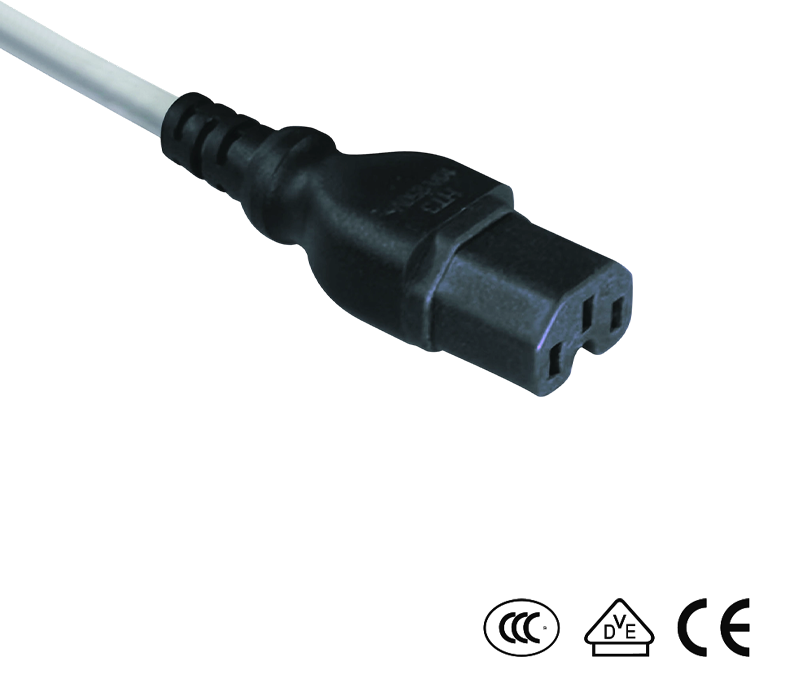
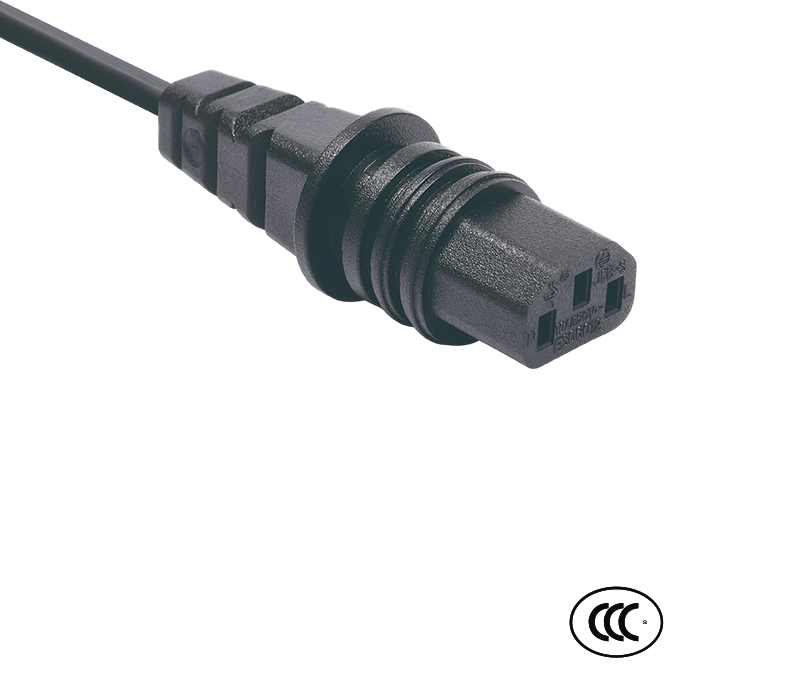
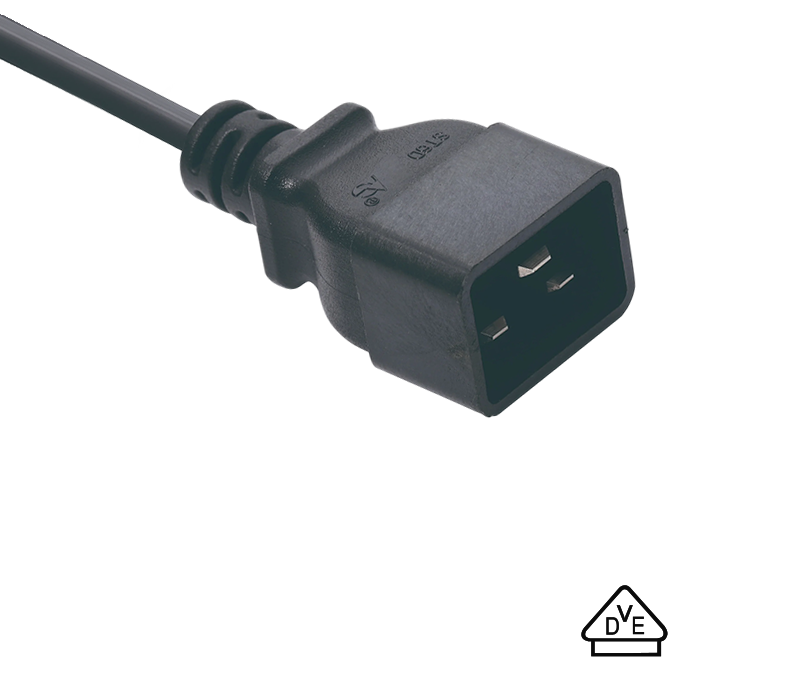
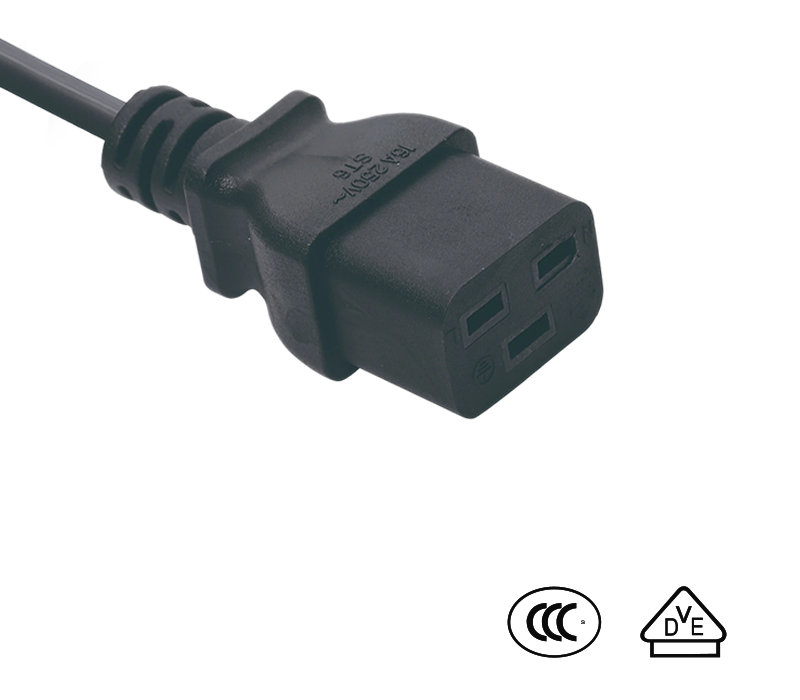
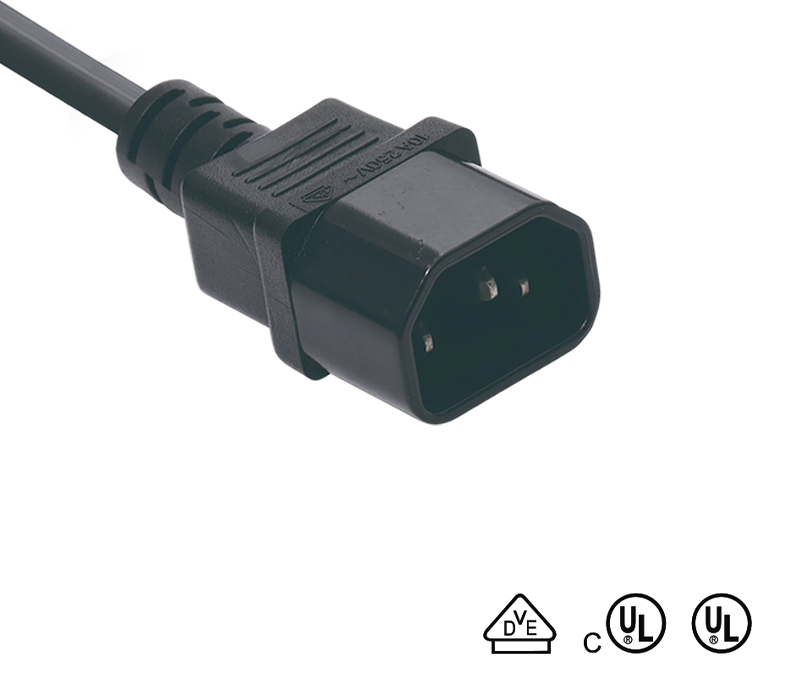
Most projects stop thinking once the wall plug is agreed, yet the coupler half of a cord set is where temperature ratings diverge. A C13 female connector to C14 male inlet is nominally 10 A, 250 V at 70 °C. Move to C15 and C16 and the rating climbs to 120 °C for kettles, heaters and similar appliances. Server and PDU loads move up again to C19 and C20 at 16 A or 20 A. Specifying a C13 for a load that runs hot is a quality complaint waiting to happen.
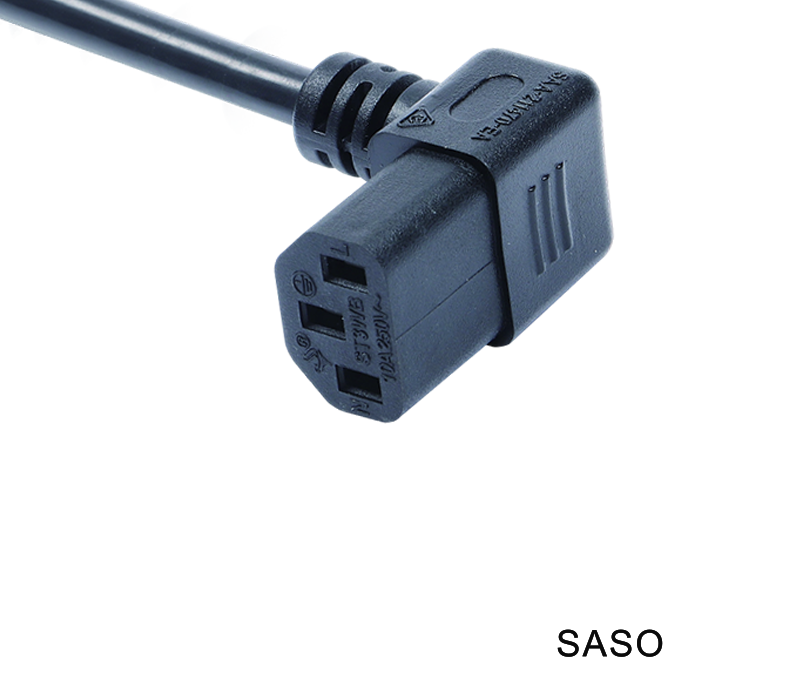
Geometry matters as much as rating. A straight C13 adds roughly 60 mm of depth behind the coupler, which is fine on a desk and awkward inside a 600 mm rack. A 90-degree angled C13 turns the cable parallel to the panel and lets the door close without straining the strain relief.
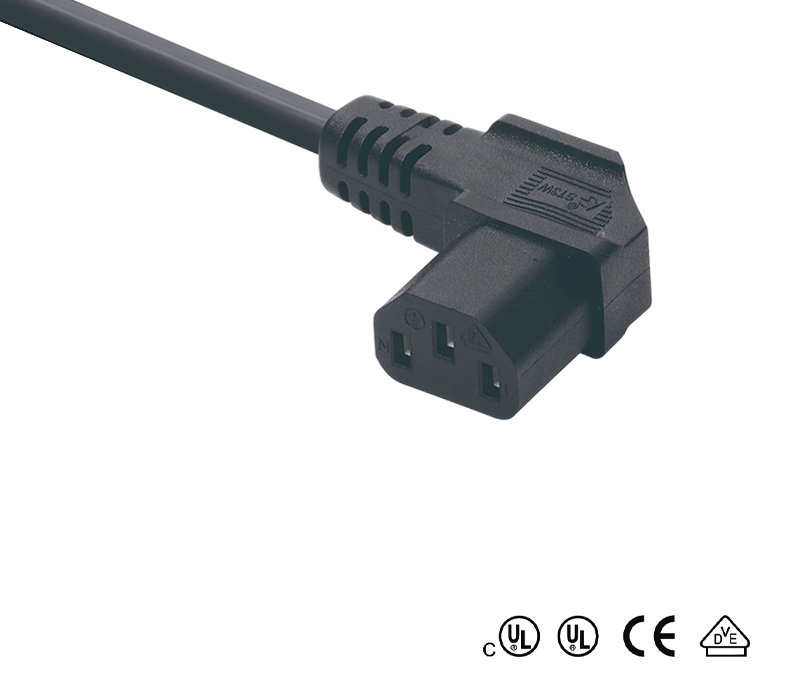 ST3W 90-Degree Angled IEC C13 Socket ConnectorAngled IEC C13 female connector rated 10A 250V, designed for space-constrained installations and multi-standard equipment where a compact, flexible power connection is needed.View Product →
Beyond the Cord: Connectors, Splitter Boxes and Lighting Kits
Buyers who order cords often need the rest of the connection chain, and sourcing it from separate suppliers multiplies both tooling cost and inspection work. A single manufacturing floor that covers the categories below usually means one drawing set, one approval sample and one shipment.
- Power cords and plugs
- Regional plug families: US, EU, UK, AU, China, Japan, Korea, Taiwan, Brazil, South Africa, Israel, Italy, Denmark, Thailand, Switzerland
- IEC connector cords: C1, C5, C7, C13, C14, C15, C17, C19, C20
- LED and lighting interconnection
- LED connector harnesses, including IP67 and Y-shaped moulded versions
- Splitter boxes in 3, 4, 6, 9 and 12 way versions, high and low voltage
- Low-voltage switches: foot switch, touch dimmer, infrared sensor
- Finished lighting
- String lights with E12, E26, E27, G40 and S14 sockets
- Cabinet, bedside and mirror-front light sets
For fixture makers, the useful overlap is the overmoulded connector. A 24 V outdoor string light with a waterproof plug, an IP67 Y-connector and a 6-way splitter box is one system, and it should be tested as one system rather than three parts that happen to fit.
What Belongs in the RFQ
A one-page request for quotation prevents most disputes later. These are the fields worth filling in before you ask for a price:
- Destination country and the plug standard required, including any local approval mark.
- Voltage, current and the appliance's worst-case ambient temperature.
- Conductor size, number of cores, jacket material and colour.
- Overall length with an explicit tolerance, plus any tolerance on stripped ends.
- Fuse rating for fused plugs, and whether the plug must be moulded or rewireable.
- Connector type and orientation on the equipment end, with a drawing or sample.
- Marking: brand, model, electrical rating and any required traceability code.
- Packaging, carton quantity and pallet configuration for the destination warehouse.
- Compliance documents required: test report, declaration of conformity, material declarations.
- Sample quantity, sample lead time and the expected annual volume band.
Verification, Logistics and the Cost of Getting It Wrong
Before mass production, a sample should pass more than a visual check: continuity and polarity on every pole, a high-potential insulation test, a dimensional check against a gauge, and a strain-relief pull test where the conductors must not shift inside the moulding. During production, 100 % electrical testing plus a defined AQL for cosmetic and dimensional defects is the normal arrangement. Ask for the test records with the shipment, not after a complaint.
Logistics decide whether the schedule holds. A plant in Yuyao, on the south bank of Hangzhou Bay, sits inside an hour's economic circle that reaches Ningbo port and the Shanghai and Hangzhou airports, which keeps both sea freight and air samples on short lead times.
Send us your drawing, target market and annual volume, and we will come back with a specification review as well as a price — the fastest way to start is to contact our engineering team with the details above. A cord set is a small part of the bill of materials and a large part of the recall risk, and the cheapest unit is always the one that never comes back.
Latest News

Contact Us
LET'S START COLLABORATING
 Ningbo TOP Electromechanical Co., Ltd.
specializes in the R&D and manufacturing of
wires & cables, plugs & sockets, waterproof LED connectors, and more. Ourproducts
meet multiple international certifications and are widely used in global markets.
STAY CONNECTED
 Phone:+86-13586690829
Tel:+86-0574-62135837-801
 [email protected]
 Sibei Industrial Yuyao City, Ningbo, Zhejiang, China
MOBILE
Copyright © Ningbo TOP Electromechanical Co., Ltd. All Rights
Reserved
 Custom Electrical Power Cord Manufacturers