


 中文简体
 Español

Heavy-Duty Power Cord Supplier: Applications, Selection Criteria, and Practical Guidance
 2026.11.12
 Industry News
A 20 A piece of commercial kitchen equipment keeps tripping at the plug, not at the breaker. The cable is warm, the plug pins are discolored, and the maintenance team has already replaced the cord once. The root cause is often not the equipment but the cord assembly: a 13 A plug on a 16 A load, a strain relief that cannot take repeated flexing, or a jacket that softens at 60°C. When you source from a heavy-duty power cord supplier, the specification should start with the actual load and the installation environment, not the catalog headline.
Here is the short answer: match the plug standard, current rating, cable jacket, and strain relief to the real duty cycle. Then verify the supplier’s test data and production controls. The rest of this guide explains how to do that without over-specifying or paying for features that do not reduce risk.
Start with the load, not the label
Heavy-duty is a relative term. A 13 A British plug can be heavy-duty in a 10 A application; it is not heavy-duty on a 16 A continuous load. For continuous duty, use the 80% rule as a first pass: a 16 A plug should carry no more than about 12.8 A continuously, and a 20 A plug about 16 A. That headroom covers normal tolerances, but it does not replace a temperature-rise test at the actual ambient temperature.
Three numbers drive the selection: rated current, rated voltage, and maximum ambient temperature. A plug rated 16 A / 250 V is not automatically suitable for a 16 A load in a 40°C cabinet. The same applies to cable. A 1.0 mm² conductor may be fine for a short 10 A lead, but a 16 A lead running 10 m needs a larger cross-section to keep voltage drop and conductor temperature under control.
Figure 1: Heavy-duty cord selection tree
- Define the load
- Continuous current: keep ≤ 80% of plug rating
- Ambient: above 30°C, derate or retest
- Match the plug standard
- North America: NEMA 5-20 for 20 A
- UK: BS 1363 with fuse
- Europe: Schuko 16 A
- Australia: AS/NZS 3112 16 A
- Specify cable and jacket
- Jacket: PVC, rubber, or TPE
- Strain relief: molded or clamped
| Plug family | Typical rating | 80% continuous guide | Common application |
|---|---|---|---|
| NEMA 5-20 (US) | 20 A / 125 V | 16 A | Commercial appliances, IT racks |
| BS 1363 (UK) | 13 A / 250 V | 10.4 A | Fused leads, portable tools |
| Schuko (EU) | 16 A / 250 V | 12.8 A | Light industrial, HVAC |
| AS/NZS 3112 (AU) | 16 A / 250 V | 12.8 A | Outdoor equipment, pumps |
The table is a starting point. If the plug is used in a hot enclosure or a wet outdoor location, the jacket and IP rating matter as much as the current rating. For example, a standard PVC jacket may stiffen in cold weather and soften in high heat; a rubber or TPE jacket can be a better fit for repeated flexing and outdoor use.
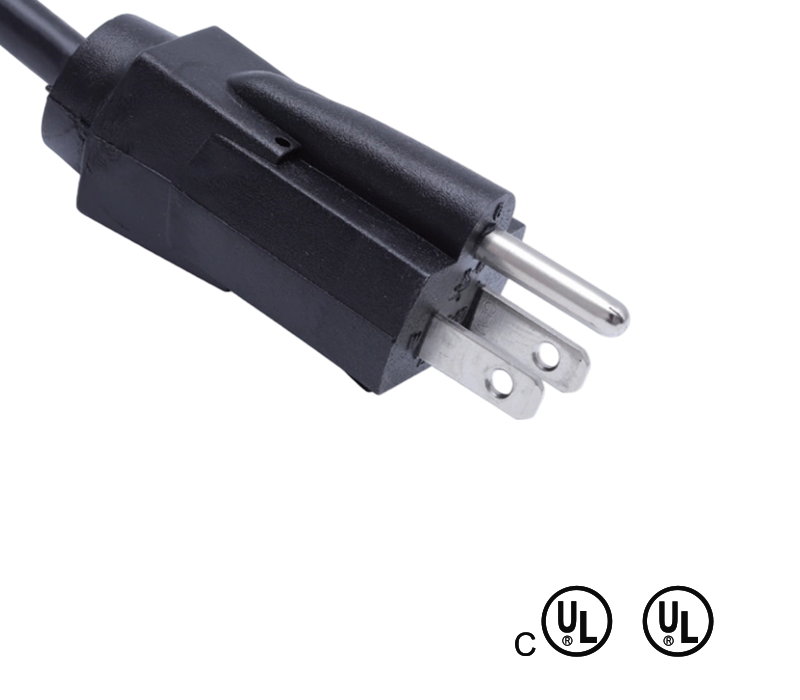 JT-3D 20A 125V American-Standard High-Current PlugFor high-current American-standard equipment, this 20A 125V three-pin plug is built for heavy-duty industrial and commercial use with several cable options.View Product →
Plug standard is a safety requirement, not a market preference
Plugs are regional safety devices. A US NEMA 5-15 plug will not mate with a 20 A receptacle, and a UK BS 1363 plug contains a fuse that must match the cord’s current rating. Shipping a “universal” adapter is not a substitute for a correctly molded plug. If the equipment is exported, the cord assembly should be built to the destination standard from the beginning.
Ask the supplier to confirm the plug standard, the fuse rating if applicable, and the applicable test standard. For a quick refresher on plug anatomy and pin configurations, see this guide to what a plug is and how its parts work. That matters when a 16 A plug is specified for a 13 A fused UK lead: the fuse, not the plug body, becomes the limiting component.
For Australian 16 A equipment, the plug body and pins must be rated for the higher current. A 10 A plug with a 16 A label is a common nonconformity.
 A3-15 16A 250V Australian-Standard High-Current PlugA 16A 250V Australian-standard plug with pure copper conductors and a fire-retardant PVC shell, suited to heavy-duty appliances such as air conditioners and water heaters.View Product →
Cable, jacket, and strain relief decide service life
The plug is only one part of the assembly. The cable jacket protects the conductors from abrasion, moisture, and chemicals. For heavy-duty use, check the jacket material, temperature range, and outer diameter. A thicker jacket is not always better: it can reduce flexibility and put more stress on the plug termination.
Strain relief is the most overlooked failure point. A molded strain relief distributes bending force over a longer length; a clamped strain relief can be serviced but must be tightened correctly. Pull tests and flex tests are more useful than a catalog claim. If the cord will be dragged, coiled, or exposed to oil and sunlight, specify the test conditions in the RFQ.
For European 16 A equipment used outdoors or in wet areas, a waterproof extension or plug assembly reduces the risk of water ingress. The design should include a sealing gasket and a cable gland that matches the cable diameter.
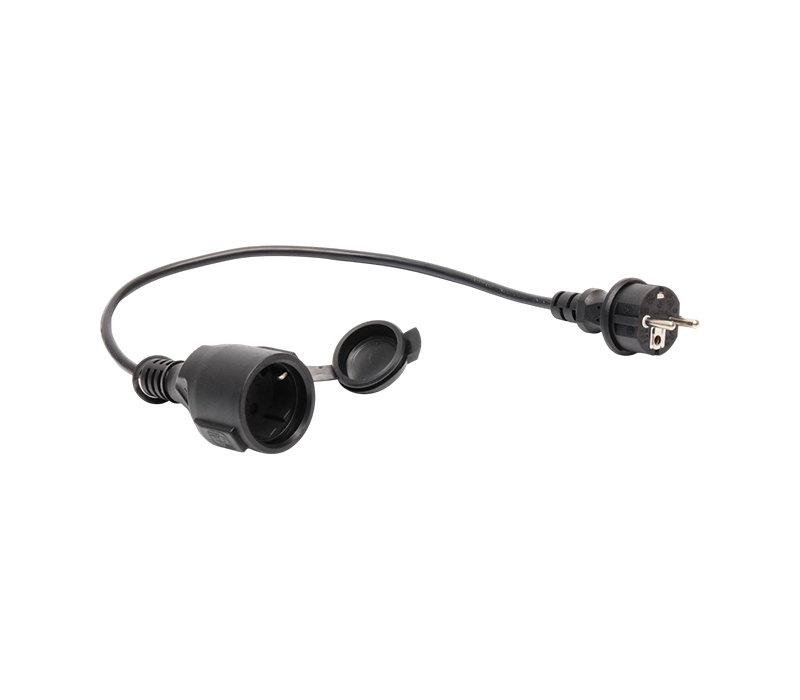 JT003-F/FY003-F+GZF3-16 16A 250V Waterproof European Extension CordA 16A 250V European-standard extension cord with a sealed housing for humid or outdoor use, suitable for power tools and outdoor lighting.View Product →
How to vet a heavy-duty power cord supplier
A supplier that can mold a plug is not automatically a heavy-duty supplier. Ask for three things: the current rating test report, the jacket material datasheet, and the strain-relief pull-test result. Then ask how the factory controls crimp height, solder temperature, and Hi-Pot testing. A supplier that cannot show these records is asking you to accept the risk.
Custom capability also matters. If you need a 90-degree plug, a specific cable length, or a labeled jacket, the supplier should be able to modify the mold or assembly without losing the safety approvals. That is different from buying a standard cord and adding a label.
Our own production is based in Yuyao, Zhejiang, within the Ningbo port and Shanghai airport logistics circle. We manufacture power cords, IEC connectors, LED connectors, and related assemblies, and we support custom lengths, plugs, and packaging. You can send your drawing and target market to request a sample and the corresponding test report.
What to put in the RFQ
An RFQ that says “heavy-duty power cord” will attract quotes for standard 13 A leads. Instead, specify the following:
- Plug standard and current rating, e.g., NEMA 5-20, 20 A / 125 V
- Continuous load and duty cycle, e.g., 14 A continuous, 8 hours per day
- Ambient temperature and IP requirement, e.g., 40°C, IP44
- Cable type, length, and jacket material
- Strain relief type and flex test requirement
- Destination market and required approvals
Add a sample inspection plan. For heavy-duty cords, check pin dimensions, polarity, fuse rating, Hi-Pot pass, pull strength, and jacket hardness after heat aging. If the sample passes, lock the construction with a golden sample and a control plan before mass production.
Total cost is not the unit price
The cheapest cord often costs more in returns, downtime, and safety incidents. A 20 A plug with a proper strain relief and a tested jacket may add a few cents per unit, but it can eliminate a field failure that costs many times that amount. Ask the supplier to quote the test report and the sample cost separately so you can compare like for like.
For a heavy-duty application, the right supplier is the one that asks about the load, the environment, and the destination standard before quoting. If the first response is a price list, keep looking. If the first response is a question about continuous current and ambient temperature, you are on the right track.
Latest News

Contact Us
LET'S START COLLABORATING
 Ningbo TOP Electromechanical Co., Ltd.
specializes in the R&D and manufacturing of
wires & cables, plugs & sockets, waterproof LED connectors, and more. Ourproducts
meet multiple international certifications and are widely used in global markets.
STAY CONNECTED
 Phone:+86-13586690829
Tel:+86-0574-62135837-801
 [email protected]
 Sibei Industrial Yuyao City, Ningbo, Zhejiang, China
MOBILE
Copyright © Ningbo TOP Electromechanical Co., Ltd. All Rights
Reserved
 Custom Electrical Power Cord Manufacturers